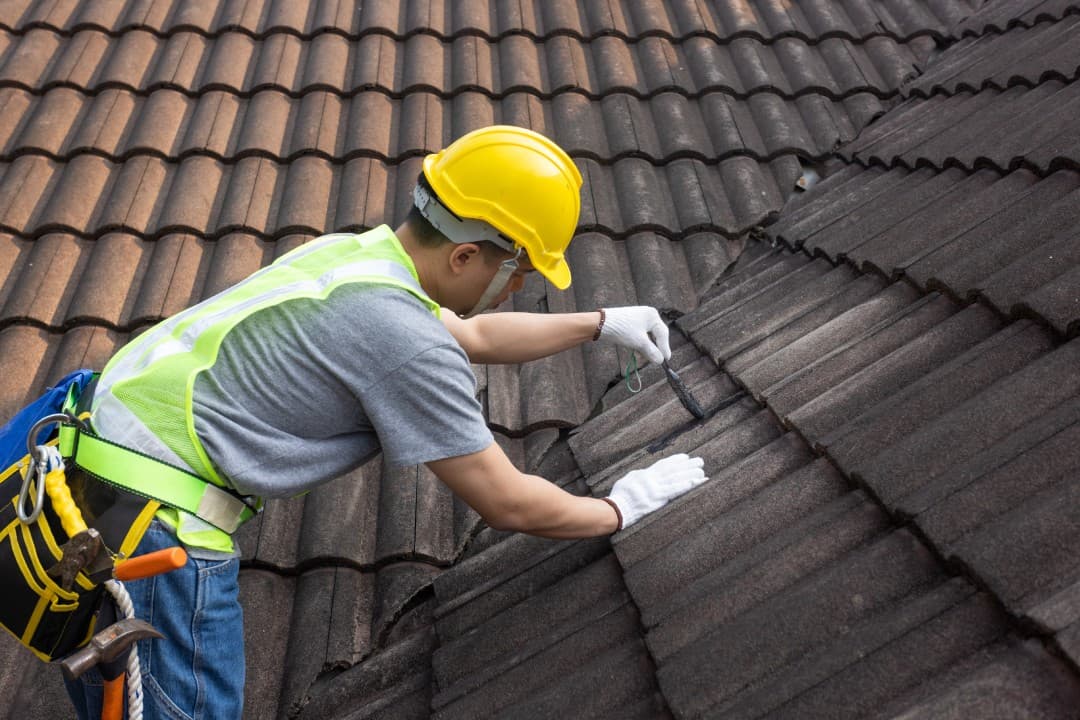
Step onto a damaged asphalt roof the wrong way and you might dent a shingle. Step onto a damaged tile roof the wrong way, and you can crack three more tiles that were perfectly fine a moment ago — which is exactly why the entire approach to storm damage tile roof repair has to start from a different set of assumptions than shingle repair does.
Tile doesn't lift and crease the way asphalt shingles do — unlike the wind damage covered in a typical shingle roof, it cracks, chips, and shatters under direct impact. Everything that follows, from inspection to repair, depends on that difference.
What Actually Breaks a Tile Roof in a Storm
Hail and flying debris are the primary culprits behind hail damage tile roof cases, striking individual clay tile roof damage or concrete tile roof repair scenarios hard enough to crack or shatter them outright rather than lifting them the way wind lifts a shingle's edge.
Wind still plays a role, but its main effect on tile is loosening fasteners and battens rather than peeling tiles back — a tile roof is far more likely to develop a scattering of broken roof tiles after a storm than one large torn section, another reason storm damage tile roof repair rarely looks like the aftermath of a shingle storm.
The Rule That Could Force a Full Replacement
Some regions, including Florida under its building code, apply what's commonly called the "25% Rule": if more than a quarter of a roof section is damaged, the entire section has to be brought up to current code — which in practice often means full replacement rather than a targeted repair, even if the visible damage looks limited.
Before assuming a repair is the obvious path, it's worth finding out whether a similar threshold applies in your area, since it can completely change the scope and cost of the project.
Tracing a Tile Leak Isn't Straightforward
Here's the detail most homeowners never expect. With a tile roof, the tile roof underlayment underneath does most of the actual waterproofing — the tiles themselves are more of a durable, weather-resistant shell on top.
That means water can enter through a small crack, travel sideways along the battens or through a tear in the underlayment, and show up as an interior leak nowhere near the tile that actually failed. Effective tile roof leak detection increasingly relies on thermal imaging and moisture detection tools rather than just tracing visible damage back in a straight line, since a cracked tile near the ridge can produce a water stain on a ceiling several feet away.
The Harvest-and-Repair Trick Most Homeowners Don't Know About
Older tile roofs sometimes use patterns or colors that are no longer manufactured, which used to mean a mismatched patch was the only option.
The real fix professionals use instead: roof tile matching by pulling undamaged tiles from an inconspicuous, non-street-facing section of the roof to replace the visibly damaged tiles up front, then patching the now-empty hidden section with the closest available match as part of a broader roof tile replacement plan. It's a genuinely clever workaround, and one of the real advantages of tile as a material — a typical tile roof is made of thousands of individually replaceable pieces, which makes this kind of selective repair possible in a way a continuous shingle or membrane roof simply can't offer.
Walking a Tile Roof Safely (or Not Walking It at All)
Walking on tile roof safety matters more than most homeowners expect:
Never walk directly on tile without knowing the proper foot placement — stepping on the wrong part of a tile is enough to crack it, adding new damage while trying to assess the old
Professionals use distribution tools and walk boards specifically because tile can't take direct point-loading the way plywood decking under shingles can
If you're not trained in tile-specific roof access, a ground-level and attic-side inspection is the safer way to assess initial damage before any repair work begins
A single fallen branch causing a puncture through the tile and underlayment is a different, more localized repair than widespread hail cracking, and worth distinguishing before calling a contractor
Documenting Damage for a Tile-Specific Claim
Note the date and likely cause of the storm damage, and if any tiles have already broken loose, keep the pieces — they help a contractor or adjuster match material and confirm cause for a tile roof insurance claim.
Because tile damage often looks less dramatic than a shingle tear-off even when it's structurally serious, thorough photos of cracks, chips, and any loosened tiles matter more here than they might for a more visually obvious asphalt claim.
Repair, Restore, or Replace?
Storm damage to a tile roof almost always falls into one of three outcomes, and the right one depends on how deep the damage actually goes, not just how it looks from the ground. Here's how to tell which situation you're actually in.
Repair: A Handful of Isolated Tiles
A handful of cracked or chipped tiles, especially if the underlayment tests solid underneath, is a straightforward, tile-by-tile repair. This is the outcome most storm damage tile roof repair calls actually end up being, since hail and debris damage is often scattered rather than uniform across the whole roof.
Restore: Underlayment or Fastening Problems Underneath
Sometimes the visible tile damage is minor, but storm stress reveals that the underlayment or fastening system underneath was already compromised — either from age or from shortcuts taken during the original installation. In this case, the fix isn't just replacing broken tiles; it's addressing what's underneath them before putting the roof back together, which is a bigger job than a simple repair but well short of full replacement.
Replace: Widespread or Code-Triggered Damage
Widespread cracking, underlayment failure across a large area, or damage crossing whatever local percentage threshold applies pushes the decision toward full section replacement instead. If replacement does become the answer, that's also the point where understanding realistic project timelines matters, since tile work generally takes longer than equivalent shingle work.
FAQ
Can individual roof tiles be replaced, or does the whole roof need to come off?
Individual tiles can almost always be replaced on their own — that's one of tile roofing's genuine advantages, as long as the underlayment beneath the damaged tiles is still sound.
Why is my tile roof leaking somewhere different than where the damage is?
Water travels along battens and underlayment before it shows up as an interior leak, so the entry point and the visible stain are often in different locations entirely.
Is it safe to inspect tile roof damage myself?
Ground-level and attic-side inspection is reasonable for most homeowners; walking directly on tile without proper technique risks cracking additional tiles and isn't recommended without training.
What if my roof tiles are an older style that's no longer made?
Professionals often use a harvest-and-repair approach, pulling matching tiles from a hidden section of the roof to replace visible damage, then patching the hidden area with the closest available match.
Does storm damage always mean a full tile roof replacement?
No — many storms cause isolated, repairable damage, though some regions have code thresholds (commonly around 25% of a roof section) that can require full replacement once damage exceeds that limit.
About Mubashir Yaqoob
Mubashir Yaqoob researches and writes practical home repair guides for Home Repair Manual, focused on translating technical roofing, plumbing, and maintenance information into clear advice for homeowners.
View all posts by Mubashir Yaqoob