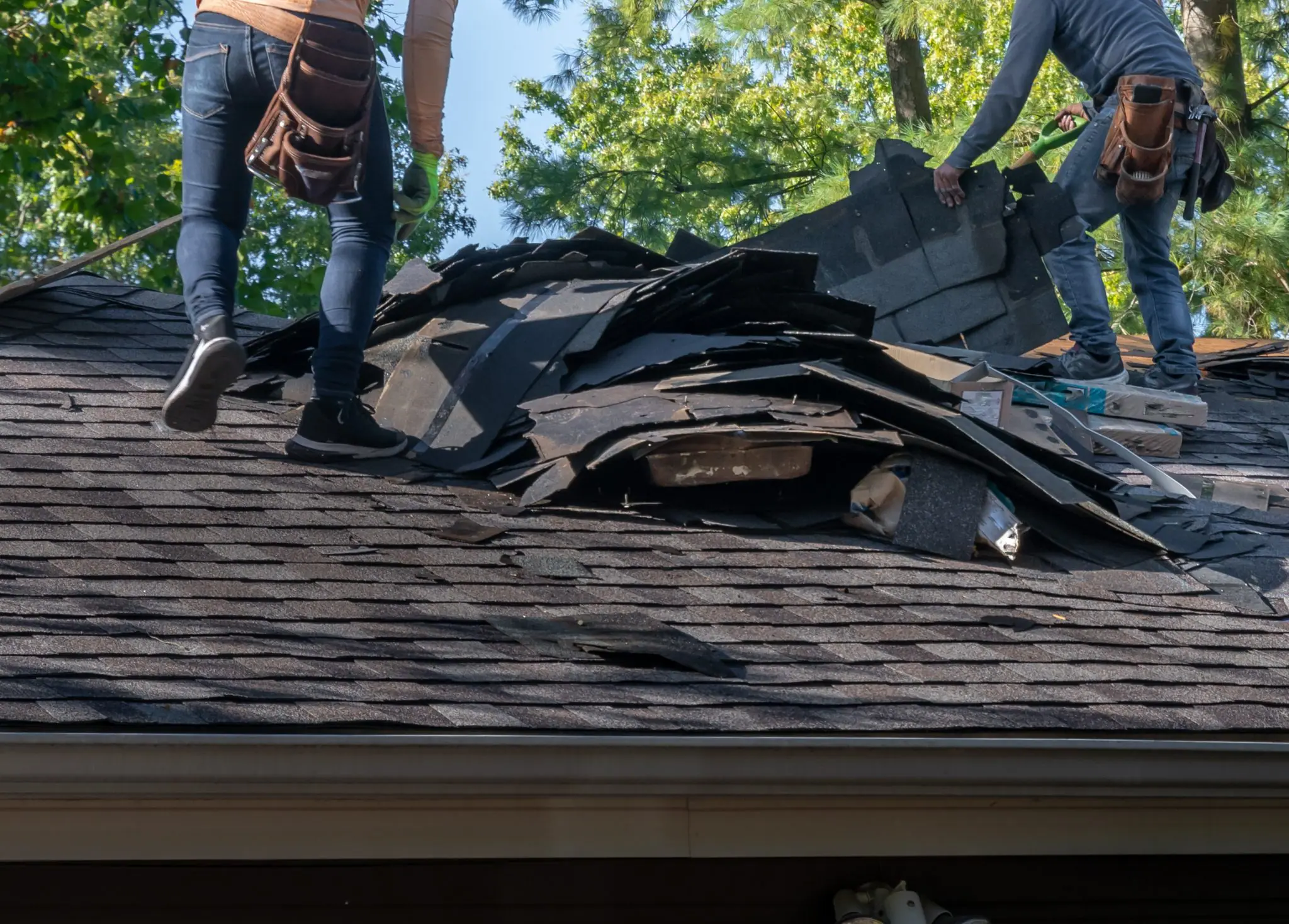
"Restoration" and "repair" get used interchangeably by most homeowners, but they're not actually the same service, and confusing them is a common reason people underestimate what a bad storm actually requires. Storm damage roof restoration is a structured, multi-phase process that treats the entire roofing system as the thing that needs to come back to full working condition — not just whatever's visibly broken.
What Storm Damage Roof Restoration Actually Means
A genuine restoration reaches well beyond whatever's visible from the ground. It takes in the underlayment, decking, flashing, and the interior protection the roof is meant to provide — which means a restoration project can involve real structural work you'd never spot from the driveway, even when the original storm damage looked fairly contained.
Here's the repair vs restoration roof distinction at a glance:
Factor | Repair | Restoration |
What's affected | A single damaged spot | The entire roofing system |
Typical trigger | Isolated damage | Widespread or structural damage |
Includes decking/underlayment check | Sometimes | Almost always |
Permit usually required | Rarely | Often, especially for full replacement |
Timeline | Hours to a day | Days to over a week |
The Restoration Process, Phase by Phase
This roof restoration timeline runs through six distinct stages, most of which a basic repair skips entirely:
1. Emergency Stabilization
Tarping exposed areas, securing loose flashing, and preventing further water entry — this happens within the first 24 hours as part of any post storm roof assessment and matters regardless of what the final scope turns out to be. The same tarping approach used for any active leak applies here as the first move.
2. Damage Assessment and Documentation
A full inspection photographs and measures every affected area, not just the obvious damage — this record becomes the foundation for both the repair plan and any insurance claim tied to it.
3. Scope Determination
This is where restoration and repair genuinely diverge. The damage gets categorized as a targeted repair, a partial restoration, or a full system replacement, based on how widespread and how deep the damage actually goes once decking and underlayment are checked, not just the surface. The most common triggers for landing on full restoration rather than a targeted repair:
Damage spread across a large enough portion of the roof that isolated patching isn't realistic
Underlayment or decking damage discovered once the surface material is pulled back, even if the visible damage looked minor
Local building code requirements that apply once a certain damage threshold is crossed, sometimes requiring the whole affected section to meet current standards
Inability to match existing roofing material closely enough for a patch to look or perform consistently with the rest of the roof
4. Permitting (When Required)
Larger restoration projects, especially anything involving decking replacement or a full reroof, typically require a permit through local building code requirements — a step a simple shingle patch usually skips entirely.
5. Execution
Work proceeds in sequence: remove damaged material, inspect and repair the decking underneath, install new underlayment, apply new surface material, then reseal every penetration and flashing junction. This is also where the timeline stretches well past what a single-day repair looks like.
6. Final Inspection and Sign-Off
For permitted work, a final inspection confirms the job meets current code before it's considered complete — the formal closing step a basic repair doesn't need.
How Long Restoration Actually Takes
A targeted repair might be done in an afternoon. A genuine restoration project runs on a different timeline entirely — the booking delay and the actual work time are two separate clocks worth understanding before you commit to a schedule, and that gap tends to widen further during restoration-heavy storm seasons when contractors are booked out further than usual.
Restoration for Different Roof Types
The core phases above apply broadly, but material changes the details. Tile roofs, for instance, fail and get restored differently than shingle roofs — cracking rather than lifting, with leak paths that travel along battens instead of showing up directly beneath the damaged spot. And the causes driving restoration in the first place are worth understanding on their own terms, covered in more detail in what actually needs fixing after wind and storm damage.
FAQ
How exactly do roof repair and roof restoration differ?
It comes down to scope. A repair addresses a single problem area; a restoration treats the entire roofing system as needing to come back to full condition — see the comparison above for how that plays out in permitting, timeline, and what gets inspected.
Does storm damage roof restoration always require a permit?
Not always — it depends on scope. Larger, decking-involved, or full-reroof projects typically do; an isolated repair usually doesn't.
How long does a full roof restoration take compared to a repair?
Repairs are often hours; restorations commonly run several days to over a week, and longer still during peak storm season when contractor schedules back up.
Does insurance typically pay for full restoration rather than a simple repair?
Often yes, particularly when documentation from the assessment phase shows the damage genuinely extends beyond what a simple repair could reasonably address.
Can a roof restoration be partial, or does it always cover the entire roof?
It can be partial — restoration means treating an entire affected section as a system, not necessarily the whole roof. A storm that damaged one slope, for example, can be fully restored there while the rest of the roof is untouched, as long as the damage doesn't cross a local code threshold that forces broader work.
What roof restoration cost factors matter most?
Scope is the biggest driver — a targeted repair might run a few hundred dollars, while a full restoration involving decking and underlayment work climbs into the thousands, varying by roof size, material, and how much of the structure underneath needs attention.
About Mubashir Yaqoob
Mubashir Yaqoob researches and writes practical home repair guides for Home Repair Manual, focused on translating technical roofing, plumbing, and maintenance information into clear advice for homeowners.
View all posts by Mubashir Yaqoob