
Every winter the same pictures make the rounds: icicles as long as a forearm, a gutter bent into a smile, a brown stain blooming on the bedroom ceiling. Then comes the ad promising that a cheap black cable will stop all of it. Self-regulating heat tape for roofs is genuinely useful, and it's also oversold.
Here's the honest version. The cable doesn't melt your snow. It keeps a narrow path open so meltwater can leave the roof instead of backing up under your shingles. That's worth paying for in the right spots and a waste in the wrong ones. This guide covers how it works, how much you need, what it costs to run, and where it can't help.
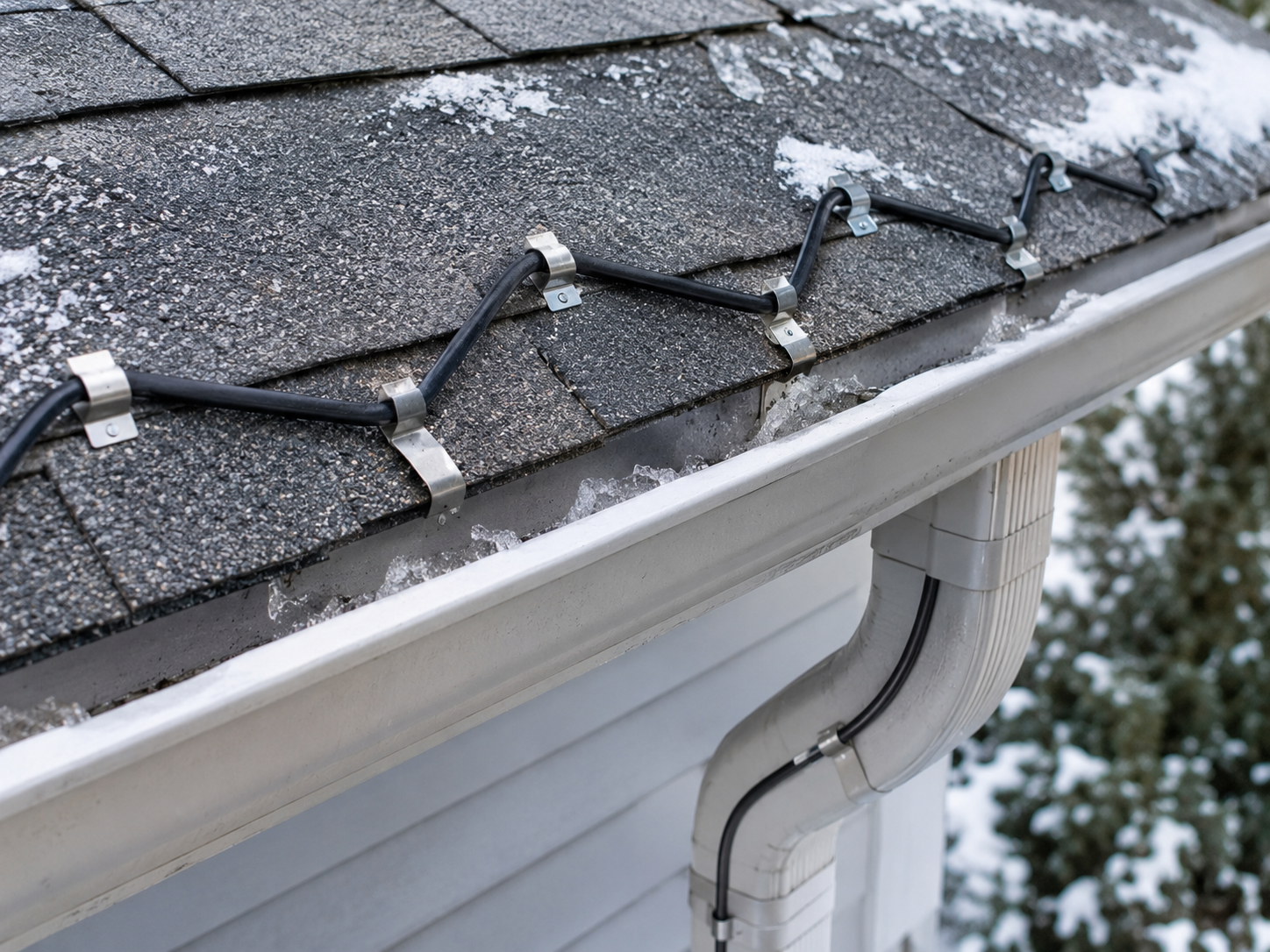
What Self-Regulating Heat Tape for Roofs Actually Does
Roof heat cable is a pair of copper wires separated by a plastic core, and the core is the clever part. When it's cold, the core conducts more electricity and gives off more heat. As it warms, it conducts less. Every inch adjusts for itself, so a stretch buried in snow runs hotter than a stretch sitting in a patch of sun.
That's the "self-regulating" bit. It's why this cable can safely cross over itself at a valley, where plain constant-wattage cable can't.
What it won't do is clear the roof. Its job is a drain channel: a warm line along the eave, through the gutter and down the downspout, so water has somewhere to go. Pipe heat tape and roof cable are different products, and swapping them is a mistake.
Fix the Cause First: Why Ice Dams Form
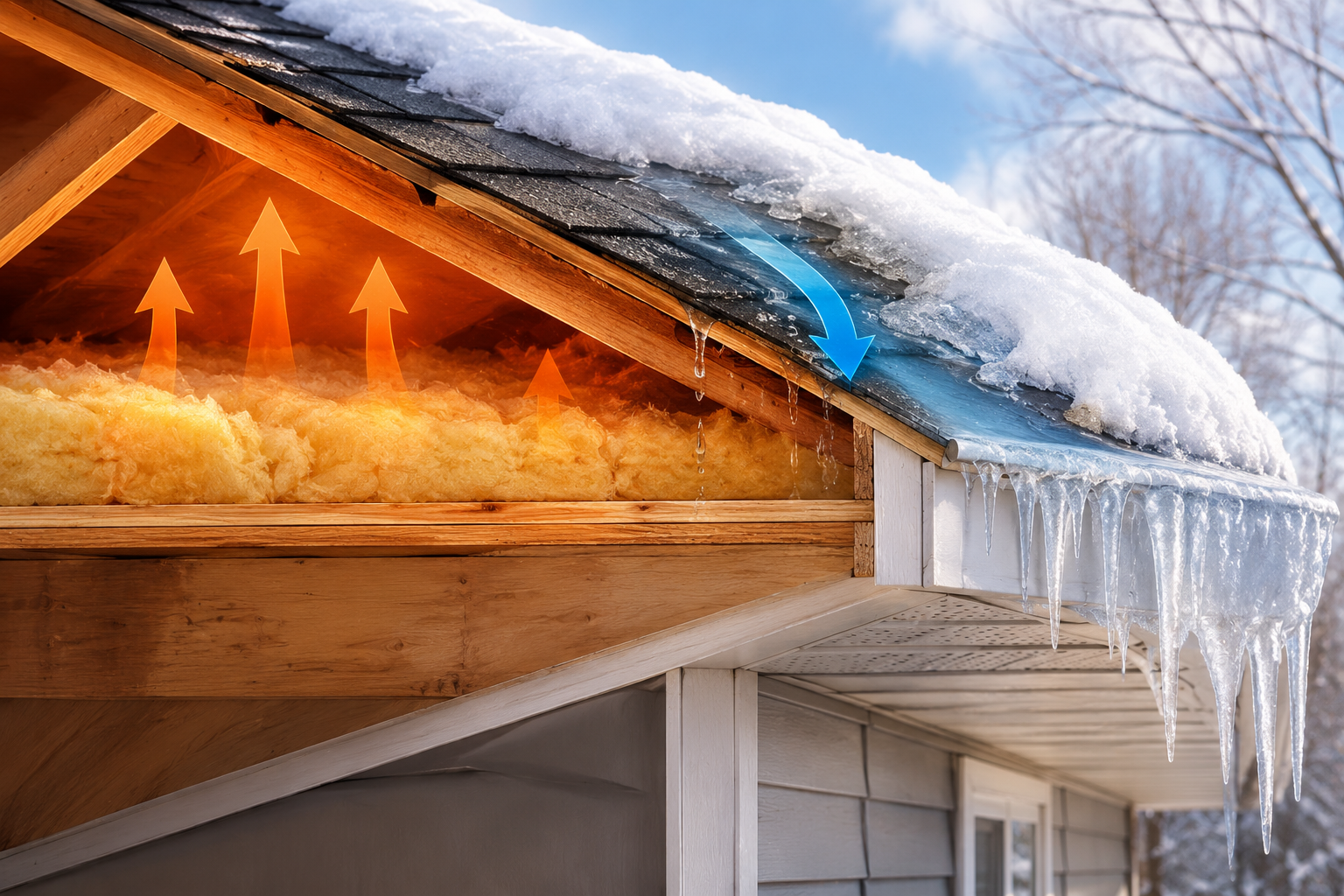
Ice dams start inside the house. Heat from the living space escapes into the attic and warms the roof deck from below, which melts the layer of snow resting against it. The water runs down to the overhang, which sits outside the heated space and stays cold, and it freezes there. The ice grows into a dam, the next melt backs up behind it, and water slips under the shingles.
That's why university extension programs and building scientists call heat cable a Band-Aid. The lasting fix is sealing air leaks into the attic (light fixtures, plumbing vents, the attic hatch) and then adding insulation. One Minnesota energy nonprofit puts a typical air sealing and insulation job between $1,000 and $4,500.
Even so, a well-sealed house can still grow ice at a cold valley or a low-slope eave, and a roof you can't re-insulate this year still has to survive this winter. That's where cable earns its place, as a backup and not a substitute. If water is already getting in, see our guides on a water stain on the ceiling after heavy rain and an emergency roof leak fix, and read about roof deck repair signs if the leaking has gone on a while.
Where It Helps Most
Self-regulating heat tape for roofs earns its keep in four places: the lowest edge of the eave, where dams start; valleys, where two slopes funnel water into one channel; gutters and downspouts that freeze solid; and the shaded side of dormers. It does very little on a plain, sunny slope that sheds snow by itself. If your trouble spot is one valley and not the whole roofline, you may only need a short run there.
Self-Regulating Heat Tape for Roofs vs. Constant-Wattage Cable
You'll see two kinds on shelves. Here's how they differ.
Feature | Constant-wattage kit | Self-regulating cut-to-length cable |
Heat output | Fixed, around 5 watts per foot | Rises when cold, drops when warm |
Cutting and overlap | Fixed lengths, no cutting, no overlap | Cut to length, safe to cross over itself |
Power | 120-volt plug-in | 120 or 240 volts, longer runs per circuit |
Upfront cost | Lower | Higher |
Best for | A short, simple eave | Valleys, dormers, long or complex roofs |
For one plain eave, a kit can do the job. Anything with valleys or dormers is easier with cut-to-length cable. Whichever you buy, check three things on the label: it says roof and gutter de-icing, it carries a recognized safety listing such as UL or ETL, and it states a maximum circuit length. Some listings sell pipe cable with roof wording tacked on, and the CPSC advises against using tape made for water pipes on gutters or roofs.
How Much Self-Regulating Heat Tape for Roofs Do You Need?
Sizing is where most guides go vague, but manufacturers publish multipliers and they're easy to use. Measure your eave length, find the overhang (the distance from the roof edge to the wall), and multiply. These factors come from one major maker's chart, so check your own package.
Eave overhang | Shingle roof, sawtooth pattern | Metal roof, loop pattern |
12 in | 1.9 | 2.5 |
24 in | 2.7 | 3.5 |
36 in | 3.6 | 4.5 |
48 in | 4.6 | 5.5 |
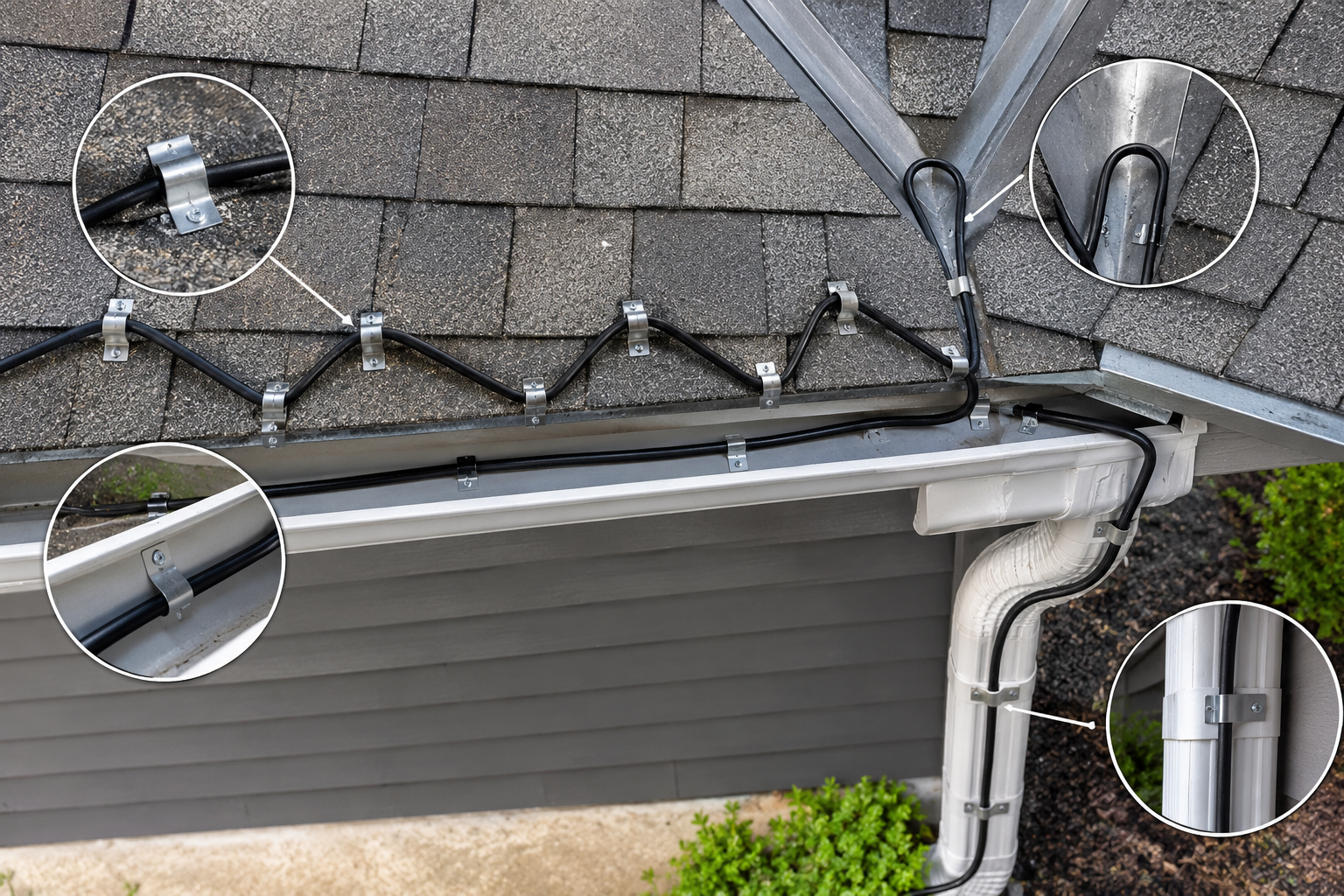
Then add the rest of the water path: 1 foot per foot of gutter (two runs if it's wider than 6 inches), 2 feet per foot of downspout because the cable loops down and back, about 6 feet per roof valley, and 1 foot per foot of dormer edge.
Here's a worked example. A 40-foot eave with a 24-inch overhang on a shingle roof needs 40 × 2.7 = 108 feet. The gutter run tacks on another 40 feet, and two 12-foot downspouts, each doubled for the trip down and back, add 24 more. That brings the running total to 172 feet. Two valleys add 12 more, for 184 feet, plus a foot or so for each power connection. Some pros use a rough rule of about five feet of cable per foot of roof edge, which matches deep overhangs, so when in doubt, trust your manufacturer's chart.
What It Costs to Run
Running cost is simple multiplication. At full power, 184 feet of 5-watt-per-foot cable is 920 watts, or 0.92 kilowatts. At an example rate of 17 cents per kilowatt-hour, that's about 16 cents an hour, or roughly $1.56 across a 10-hour storm. Self-regulating cable draws less as it warms, so treat that as a ceiling. Plug in your own rate.
The costly mistake is leaving it on all winter. Add a snow and ice sensor or a thermostat control so it only runs when there's moisture near freezing, and switch it off in spring.
Installing It: What Pros Check That DIY Guides Skip
Plan the whole water path. Eave, gutter, downspout and out at the ground. If the bottom of the downspout is frozen, meltwater just refreezes above it. Our guide to the gutter apron explains how water should leave the roof edge, and drip edge vs. gutter apron covers the edge details that decide whether water reaches the gutter at all.
Use roof clips. Never staple or nail through the cable. Lay a sawtooth on shingles and loops on metal, and keep the cable off sharp edges. Clip spacing varies by maker (one specifies 24 inches, another about 16), so follow your package. On metal roofs, deal with loose panels and rust first, as covered in our guide to fixing metal roof leaks.
Respect the circuit limit. Self-regulating cable draws the most current at a cold start, so makers publish maximum lengths for each breaker size. Don't go over them.
Get ground-fault protection. Many manufacturers say the National Electrical Code calls for 30 mA ground-fault equipment protection on this kind of heater. Hardwiring a 240-volt circuit is electrician territory.
Test it. Run the maker's continuity checks, then power it up and wait. One manufacturer says standing water in the gutter should feel warm within an hour.
Mistakes That Waste Money
The usual ones are cable that's too short, so ice builds above it, skipping the downspout, running it with no sensor, cutting a constant-wattage kit, and treating cable as the cure for a leak that's already inside. Check it every fall, and our DIY home inspection checklist is a handy place to fold that in. Don't install it in extreme cold either, since one maker's limit is 0°F.
When to Call a Pro
Call a roofer or electrician if the roof is steep or icy, if the cable needs hardwiring, if water is already inside, or if the same valley dams up every year. A roofer can check flashing and the underlayment, and an energy auditor can find the attic leaks that start the whole problem.
FAQ
Is self regulating heat tape for roofs worth it? In the right spots, yes: stubborn eaves, valleys and gutters. As the only answer to a leaky, under-insulated attic, no.
Does self regulating heat tape for roofs melt all the snow? No. It melts a channel for water to escape.
Does it work on metal roofs? Yes, but metal roofs use a loop pattern and need more cable, as the sizing table shows.
Can I leave it plugged in all winter? You can, but it wastes power. Use a sensor or thermostat.
Will pipe heat tape work in a gutter or on shingles? No. Buy cable made and labeled for roofs and gutters.
How long does it last? There's no single number. Inspect it every fall and replace anything cracked or damaged.
Final Thoughts
Self-regulating heat tape for roofs works best as a backup to a sealed, insulated attic, not a replacement for one. Size it with real numbers, protect the whole water path and put it on a sensor.
About Mubashir Yaqoob
Mubashir Yaqoob researches and writes practical home repair guides for Home Repair Manual, focused on translating technical roofing, plumbing, and maintenance information into clear advice for homeowners.
View all posts by Mubashir Yaqoob