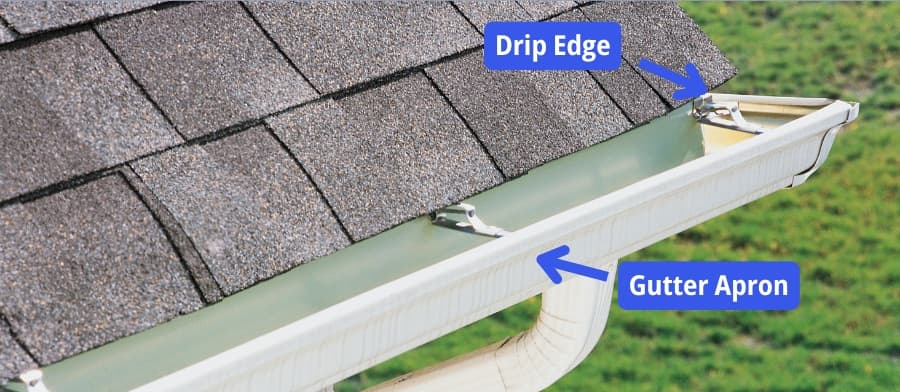
Drip edge vs gutter apron is one of the most confusing comparisons in roofing, even among homeowners who've had a roof replaced. Both are pieces of metal roof flashing that manage water at the roof's edge — but they're not interchangeable, and mixing them up is a common reason fascia boards rot a few years down the line.
What Is a Drip Edge
A drip edge is a strip of formed metal flashing installed along the rake edges of a roof — the sloped sides running from ridge to eave, not the horizontal bottom edge. It gives water a controlled place to leave the roof instead of wicking under the shingles or running down the fascia.
Most drip edge has a short overhang, typically ½ to ¾ inch past the roof deck, in a T-shape or L-shape profile. It's installed over the underlayment at the rakes — reversing this order is a common flashing mistake on lower-quality jobs.
Most codes, including the IRC, require drip edge on roof edges. It's inexpensive to install correctly, and skipping it doesn't show consequences right away — it shows up years later as soft, discolored fascia.
Where it goes: Primarily the rakes. Material: Aluminum, galvanized steel, occasionally copper.
What Is a Gutter Apron
A gutter apron is a close cousin of drip edge, built to bridge the gap between the roof deck and the gutter's back wall along the eaves — the horizontal edge where gutters mount.
Where drip edge has a modest overhang, a gutter apron extends further with little to no overhang past the roof edge, because its job is different: it physically directs water into the gutter trough rather than just creating a drip line. This matters because gutters get replaced more often than roofs, and a new gutter doesn't always sit flush against an older roofline. Gutter apron installs under the shingles, over the roof deck, and above the gutter's back flange.
Where it goes: Only the eaves, above the gutters. Material: Same as drip edge, usually with a matching paint finish.
Key Differences
Feature | Drip Edge | Gutter Apron |
Location | Rakes (sloped sides) | Eaves (over gutters) |
Overhang | Short, ½"–¾" | Longer, minimal overhang |
Profile | T-shape or L-shape | L-shape, extended flange |
Function | General edge protection, drip line | Directs water into the gutter trough |
Underlayment order | Over underlayment at rakes | Under first shingle course, over deck |
The short version: drip edge protects the roof edge generally; gutter apron solves the specific problem of water sneaking behind the gutter.
Why Most Roofs Use Both
These aren't competing products — a properly detailed roof typically pairs them: gutter apron at the eaves, feeding water into the trough, and standard drip edge at the rakes. If a roofer says they're installing "drip edge" across the whole roof, ask what's going in at the gutter line — some use the terms loosely, and the performance difference at the eaves is real.
How to Tell Which One You Have
From the ground, compare your eaves to your rakes. At the eaves, if the flashing extends noticeably over the gutter with almost no overhang, that's a gutter apron. At the rakes, a shorter lip with a visible ½–¾ inch overhang is standard drip edge. If both edges look identical, your roof likely has only standard drip edge everywhere — the gap-behind-the-gutter risk hasn't been specifically addressed.
Signs of Failing or Missing Flashing
Dark staining or streaking on the fascia below the gutter line
Soft or spongy fascia when pressed
Peeling paint near the roof edge
Rust or separation at overlap joints
Water marks on the soffit, similar to what shows up with leaks reaching the underside of a roof
Left unaddressed, water intrusion at the roof edge can eventually contribute to structural issues like a sagging roofline, so catching these signs early is far cheaper than waiting — repair costs climb fast once rot spreads.
Cost & Installation Tips
Material costs for both are close per linear foot; labor is usually the bigger cost factor.
Get the underlayment order right at each location — reversing it is a common, damaging error
Overlap joints by at least 2 inches
Use corrosion-resistant roofing nails
If there's more than about ½ inch of gap between the roof edge and the gutter, gutter apron is usually the better choice
Ask whether your roofer installed both, especially if gutters were replaced separately
If shingles are missing or lifted near the edge in the meantime, a temporary fix for missing shingles protects the deck and flashing underneath until a permanent repair is scheduled.
Pros and Cons
Drip edge: Protects the full roof perimeter and meets code — but doesn't solve gaps at the gutter line.
Gutter apron: Solves the water-behind-the-gutter problem, valuable after a gutter replacement — but only covers the eaves.
FAQ
Can gutter apron replace drip edge everywhere? No — it's built for the eave line only. Rakes still need standard drip edge.
Do I need both? In most properly detailed systems, yes — gutter apron at the eaves, drip edge at the rakes.
Is gutter apron required by code? Standard drip edge usually is, under the IRC. Gutter apron is often an added measure rather than a strict requirement, though many roofers recommend it in heavy-rainfall areas.
What's the cost difference? Close per linear foot. Labor matters more than material either way.
Can I add gutter apron without a full roof replacement? Often yes, since it can tuck under the existing starter course of shingles.
About Mubashir Yaqoob
Mubashir Yaqoob researches and writes practical home repair guides for Home Repair Manual, focused on translating technical roofing, plumbing, and maintenance information into clear advice for homeowners.
View all posts by Mubashir Yaqoob