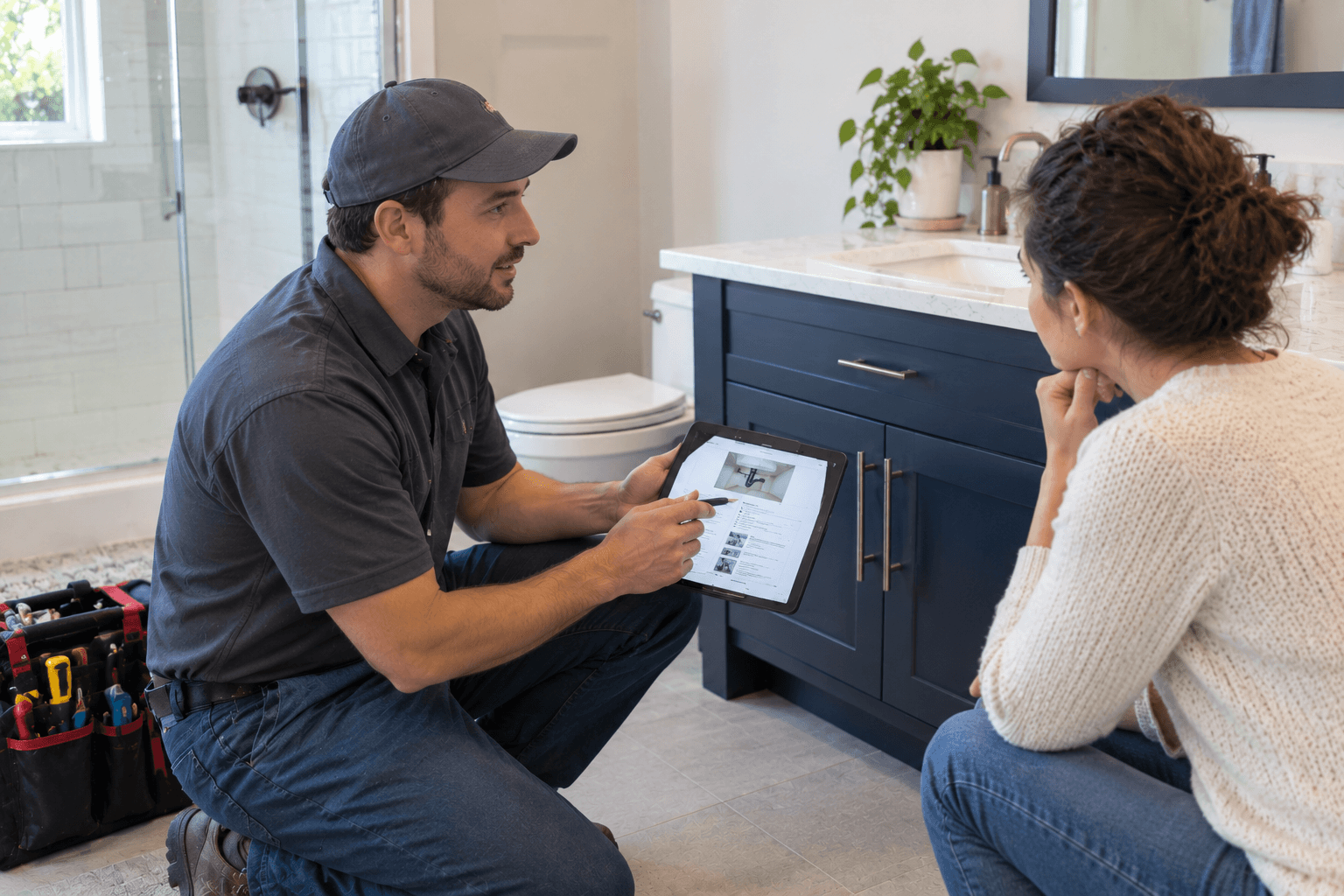
Hiring a plumber feels oddly high-stakes. You're inviting a stranger into your home, agreeing to a bill you can't predict, and trusting what happens behind the wall to hold up for years. Most people shortcut the process and call whoever answers first.
A little structure fixes that. This guide shows how to hire a plumber you can trust, then how to use a plumber well once they're on the job, so you pay a fair price and get work that lasts.
General advice only. Licensing, permit and insurance rules differ by state and country, so check what applies where you live.
How to Hire a Plumber in 6 Steps
Here's the process at a glance:
Find a professional who handles your specific type of repair
Build a short list of three
Run a quick 15-minute background check
Describe the problem and ask a few pointed questions
Compare written quotes line by line
Work with the plumber on site, then check the job before you pay
Step 1: Find a Professional Who Handles Your Specific Type of Repair
Plumbing isn't one skill. Someone brilliant at bathroom remodels may not be who you want at midnight with a flooded basement. Finding a technician who spends their days fixing your exact issue means a quicker fix and a fairer invoice.
Job | Who to look for | Worth knowing |
Burst pipe, sewage backup, no water | An emergency or 24-hour plumber | Expect a higher after-hours rate |
Leaky faucet, running toilet, small repair | A general repair plumber | A regular daytime slot is usually fine |
Water heater failure or replacement | A plumber who installs water heaters often | Confirm if they will haul away the broken system for you |
Remodel, new fixtures, rerouted pipes | A plumber who handles installs and permits | Ask who pulls the permit |
Gas line work | A plumber or gas fitter licensed for gas | Gas licensing is separate in many places |
Not sure whether it's an emergency? Our guide to the signs of a burst pipe shows what to look for, and if your water heater is acting up, this breakdown of what usually fails helps you describe the problem accurately.
Step 2: Assemble Your Shortlist
Three names is enough to compare, and few enough that you'll actually make the calls.
Start with people. A neighbor who needed the same repair is worth more than a dozen anonymous reviews.
Scan community forums for specific praise. Keep an eye out for mentions of punctuality or technicians who walked the customer through the fix.
Use manufacturer lists for water heaters and fixtures. Brands often publish certified installers.
Treat top-of-page ads with caution. Being first in search means they paid for the slot, nothing more.
Audition one when nothing is broken. A small job, like a slow drain, shows how a plumber communicates before a crisis.
Living in an older house? Look for plumbers who mention galvanized pipe or cast-iron drains. Our guide to plumbing issues in older homes explains why that experience matters.
Step 3: Run a Quick 15-Minute Background Check
Fifteen focused minutes filter out most problems.
License. Get their credentials and verify them directly with your local or state regulatory agency. Check the name, the status, and any complaints.
Insurance. Ask for a certificate of insurance, ideally sent straight from their insurer. Liability coverage protects your property, and workers' compensation matters if they have employees.
Reviews. Skip the star average and read the three-star reviews. They're often the most honest, and they show how the company handles problems.
Permits. If the job needs one, ask who pulls it and who schedules the inspection.
A plumber who bristles at these requests has already told you something useful.
Scale your effort to the job:
Job size | Vetting depth |
Small repair, like a faucet or running toilet | License check and one or two reviews |
Mid-size job, like a water heater swap | Full check above and two or three written quotes |
Big project, like re-piping or a remodel | Full check, references, a written contract, and permit details |
Step 4: Describe the Problem and Ask Pointed Questions
Start the call with facts, not a guess at the fix. Say where the problem is, what you see or hear, when it started, and whether it's getting worse. Clear details lead to a more accurate phone estimate.
Ask | A good answer sounds like |
"Have you handled this exact problem before?" | A specific example, not a vague yes |
"Will you diagnose first and quote before starting?" | Yes, with a written estimate |
"Do you charge a diagnostic trip fee, and does that cost roll into the final price of the fix?" | A clear number and a clear policy |
"Who does the work, you or a subcontractor?" | A straight answer, and credentials for either |
"What does your availability look like, and what is the expected turnaround time?" | An honest, specific arrival frame rather than an empty guarantee to fit you in immediately. |
"What does your warranty cover?" | A written breakdown that clearly separates the cost of hardware from the cost of the work hours. |
Step 5: Compare Quotes Line by Line
You can only truly evaluate estimates if they outline identical project parameters. Ask each plumber to put the scope in writing, then compare the details, not just the total. Evaluating the actual components of an estimate ensures you utilize professional services effectively and avoid overpaying.
For a rough benchmark, Bob Vila lists a typical range of $180 to $489, with a national average near $331. Your number will move with the job, parts, timing, and location.
Scope: what's included and what isn't
Parts: new or reused, which brand and who supplies them
Labor: flat price or hourly, with an estimate of hours
Extras: permits, cleanup and disposal of old parts
Timeline and warranty: start date, finish date and what's covered
The cheapest quote isn't automatically wrong, but a price far below the others usually means something's missing, so ask what.
How to Use a Plumber Without Wasting Time or Money
Hiring is only half the job. The other half is working with the plumber once they arrive, and a few habits make a visible difference to the bill.
Make a one-page house sheet. List your shut-off locations, pipe materials, water heater age and past repairs, and keep a copy handy. Our guide to general plumbing maintenance shows what to track.
Share pictures before they head out. This gives the technician a chance to stock up on necessary hardware before driving over.
Bundle small jobs. A dripping faucet, a slow drain, and a loose toilet seat cost less together than three trips.
Have them evaluate the root issue before touching anything. Try asking: "What exactly triggered this breakdown, and what choices do I have for fixing it?”
Approve changes in writing. If the job grows, get the new price by text or email before work continues.
Ask to see old parts. A good plumber won't mind.
That's the quiet secret of how to use a plumber well: stay curious, stay in the loop, and keep it in writing.
Red Flags That Should Make You Pause
Part of how to use a plumber safely is knowing when to walk away. Keep your guard up if you encounter any of the following:
A refusal to share a license number or proof of insurance
Aggressive sales tactics urging you to sign a contract immediately before a special promotion "disappears."
A big cash deposit before any work, or cash-only payment
An unwritten estimate, or pricing written on a scrap piece of paper
A claim that everything needs replacing, with no explanation
Even a single warning sign warrants hitting pause and asking clarifying questions. Two or three is a reason to call the next name on your list.
After the Job: Check Before You Pay
Take ten minutes before the plumber leaves.
Test it. Run the water, flush the toilet, open the cabinet, and feel the pipes for dampness.
Look again later. Check once that evening and again the next morning, since slow leaks show up late.
Get paperwork. An itemized invoice that matches the quote, plus the warranty in writing.
File it. Keep photos, the invoice, and the warranty in one folder.
Watch for hidden damage. If you suspect a slow leak went unnoticed for a while, refer to our structural checklist to identify hidden moisture problems.
FAQs
1. What steps should I take to verify a plumbing license?
Ask the contractor for their official registration number. Take that information to your local municipality's or state's official web portal to verify that the credentials are valid, current, and clear of active disciplinary actions.
2. How do I proceed if I have a sudden plumbing emergency?
Immediately close your main water valve to halt flooding, document the damage with photographs, and reach out to a certified emergency plumbing provider. Inquire upfront about premium emergency rates or diagnostic trip fees before authorizing them to send a technician.
3. How to use a plumber for a small job like a leaky faucet?
Book a regular daytime slot, send photos ahead and ask for a flat price. Bundle any other small fixes into the same visit to save on call-out fees.
4. What if I'm unhappy with the work?
Contact the company first with your photos and invoice, and give them a chance to put it right. If that goes nowhere, your licensing board or consumer protection office can advise you.
The Takeaway
Hiring well comes down to five habits: match the plumber to the job, check the license and insurance, ask a few pointed questions, compare quotes line by line, and inspect the work before you pay. That's how to hire a plumber without second-guessing yourself, and how to use a plumber so the next visit is faster and cheaper. Log a vetted technician's contact info into your smartphone contact list ahead of time so you aren't scrambling during a midnight emergency.
About Mubashir Yaqoob
Mubashir Yaqoob researches and writes practical home repair guides for Home Repair Manual, focused on translating technical roofing, plumbing, and maintenance information into clear advice for homeowners.
View all posts by Mubashir Yaqoob