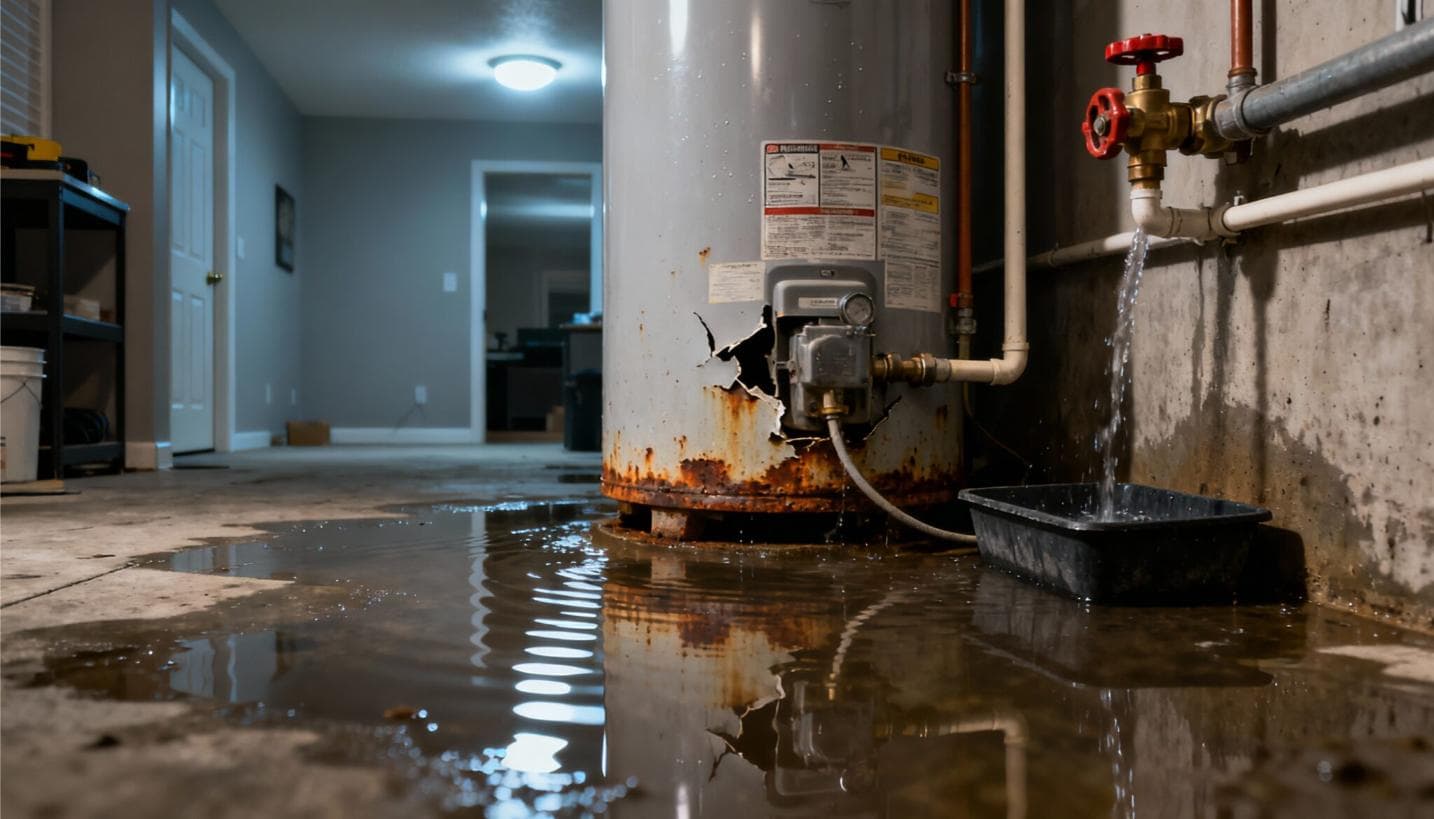
Rusty water, strange noises, a slow leak that shows up months later — these usually get listed as separate, unrelated warning signs. In most cases, they're not separate at all. They're chapters in the same story, and that story almost always starts with one small, inexpensive part most homeowners have never heard of.
That part is the anode rod, and understanding what it does is the fastest way to actually make sense of the real signs of a failing water heater, instead of just memorizing a checklist.
Signs of a Failing Water Heater: What They Have in Common
A water heater tank is lined to resist corrosion, but that lining isn't the real first line of defense — the anode rod is. These water heater warning signs almost always trace back to that same root cause once you know what to look for.
A few things worth noticing across nearly every symptom on this list:
They Rarely Show Up Alone
One early sign is often followed by a second within weeks or months, not years. If you've noticed a new noise and also caught a faint change in water color around the same time, that's not a coincidence — it's usually the same underlying failure showing up in two different places at once. Treating each symptom as its own isolated problem is how people end up chasing individual fixes instead of addressing the actual cause.
Nearly All Trace Back to One Part
Most of these symptoms, directly or indirectly, connect to anode rod depletion and the sediment or corrosion it allows to build up once it's gone. The anode rod is a sacrificial metal rod designed to corrode instead of your tank, attracting corrosive minerals in the water so the tank lining itself doesn't take the damage — and once it's fully depleted, usually somewhere around the 5-8 year mark depending on water quality, that corrosion has nowhere else to go but the tank itself. That's genuinely useful to know, since it means you're not dealing with five separate potential problems — you're dealing with one root cause expressing itself five different ways depending on how far the corrosion has progressed.
There's a Rough Order to How They Appear
Noise and water discoloration tend to show up first, as sediment and corrosion begin building inside the tank. Pressure and temperature issues typically follow next, as that internal damage progresses further and starts affecting how the system actually performs. Visible leaks are almost always the last stage, appearing only once the tank itself has been compromised.
Catching It Early Actually Matters
Noticing the earlier signs — noise, discoloration — gives you real decision time to plan a repair or replacement on your own schedule, rather than reacting to a leak that's already compromised the tank.
The Symptoms, and What's Actually Behind Each One
Here's the quick-reference version before the full explanation of each:
Symptom | Likely Cause | Urgency |
Rusty or discolored water | Depleted anode rod, tank corrosion | High |
Rumbling, popping, banging | Sediment buildup | Medium |
Rotten egg smell | Bacteria reacting with anode rod | Low-Medium |
Lukewarm or inconsistent temperature | Failing heating element or thermostat | Medium |
Declining water pressure | Valve issue, sediment, or developing leak | Medium |
Visible leaks or pooling | Advanced tank corrosion | Urgent |
Rising energy bills, no usage change | Sediment insulating heating element | Low |
1. Rusty or Discolored Water
Once anode rod failure begins, corrosion particles start showing up directly in your rusty hot water. This is one of the clearest signs the rod is gone and the tank lining has started taking damage it was never meant to absorb.
2. Rumbling, Popping, or Banging Noises
Among the most common water heater noise causes, water heater sediment buildup at the tank's bottom traps small pockets of water that boil and pop as they're heated, creating the noise — closely related to other unusual water heater sounds worth investigating. This isn't directly caused by the anode rod, but a depleted rod accelerates sediment buildup by letting more mineral corrosion accumulate unchecked.
3. A Rotten Egg Smell in Hot Water
This one has a different, specific mechanism: sulfate-reducing bacteria reacting with a magnesium anode rod produce hydrogen sulfide gas, which smells like sulfur. Ironically, this particular symptom means the rod is still present and reacting — it's a maintenance issue, not necessarily tank failure, and often resolves with a tank flush or an anode rod swap to a different material like aluminum or zinc.
4. Inconsistent or Lukewarm Water Temperature
Usually points to a failing heating element or thermostat rather than the tank itself, though heavy sediment buildup can also insulate the heating element enough to reduce its effectiveness.
5. Declining Water Pressure
A leaking pressure valve, sediment restricting flow, or a developing leak in the tank or connecting pipes can all show up first as reduced pressure before anything else becomes obvious.
6. Visible Leaks or Pooling Water
The clearest, least ambiguous of all water heater leak signs — worth troubleshooting immediately rather than waiting, since by the time a tank is actively leaking, the corrosion damage behind it is typically advanced.
7. Rising Energy Bills With No Usage Change
A failing unit works harder to produce the same hot water, whether from sediment insulating the heating element or general system inefficiency as components age.
One Root Cause, Several Warning Signs
The temperature and pressure relief (TPR) valve exists specifically to release dangerous pressure buildup before it becomes a real safety hazard. Corrosion and mineral buildup can cause this valve to seize, and while total TPR valve failure is rare, it's the one component on this entire list where "wait and see" isn't a reasonable response — a valve that won't open under pressure removes the system's actual safety margin. If you notice water around the TPR valve or can't get it to test properly, that's worth addressing immediately, not adding to a general maintenance list.
Tank vs. Tankless: The Signs Aren't Identical
Everything above assumes a traditional tank water heater, but tankless water heater problems show up differently. Instead of sediment settling at a tank bottom, tankless units accumulate scale inside the heat exchanger itself, which shows up as reduced flow rate or inconsistent temperature rather than rumbling noises. Tankless systems also don't have the same rust-in-the-water risk, since there's no standing tank to corrode — a tankless unit producing discolored water more often points to old house piping upstream, similar to issues covered in older home plumbing systems, not the unit itself.
Repair or Replace? A Real Decision Framework
Age is the first filter for any water heater repair vs replace decision: most tank water heaters last a typical water heater lifespan of 8-12 years, while tankless systems often reach 20. A unit past that range showing any two symptoms from the list above is generally a stronger replacement candidate than a repair one, since the same repair-vs-replace math worth applying to other home systems holds true here — a repair costing more than roughly half of a new unit rarely makes financial sense on a system already near the end of its expected life.
A younger unit with a single, isolated symptom — noise from sediment, or a rotten egg smell — is usually a maintenance fix, not a replacement decision. The math only shifts once multiple systems are failing at once, which is a sign of general deterioration rather than one fixable part.
FAQ
What is the very first sign a water heater is failing?
Strange noises from sediment buildup are typically the earliest sign, often appearing well before any visible leak or water quality change.
Is rusty hot water always a sign of a dying water heater?
Usually, yes, if it's coming from the hot side only — that points to internal tank corrosion following anode rod depletion, though old galvanized pipes can occasionally be the source instead.
How long do water heaters actually last?
Traditional tank units typically last 8-12 years; tankless systems can last up to 20 years with reasonable maintenance.
Can a failing water heater be dangerous, not just inconvenient?
Yes — a stuck or failed TPR valve removes the system's pressure safety margin, which is the one symptom on this list worth treating as urgent rather than routine.
Do tankless water heaters show the same warning signs as tank models?
Not exactly — tankless units are more prone to reduced flow and scale buildup in the heat exchanger than the sediment-driven noise and rust issues common to tank systems.
About Mubashir Yaqoob
Mubashir Yaqoob researches and writes practical home repair guides for Home Repair Manual, focused on translating technical roofing, plumbing, and maintenance information into clear advice for homeowners.
View all posts by Mubashir Yaqoob