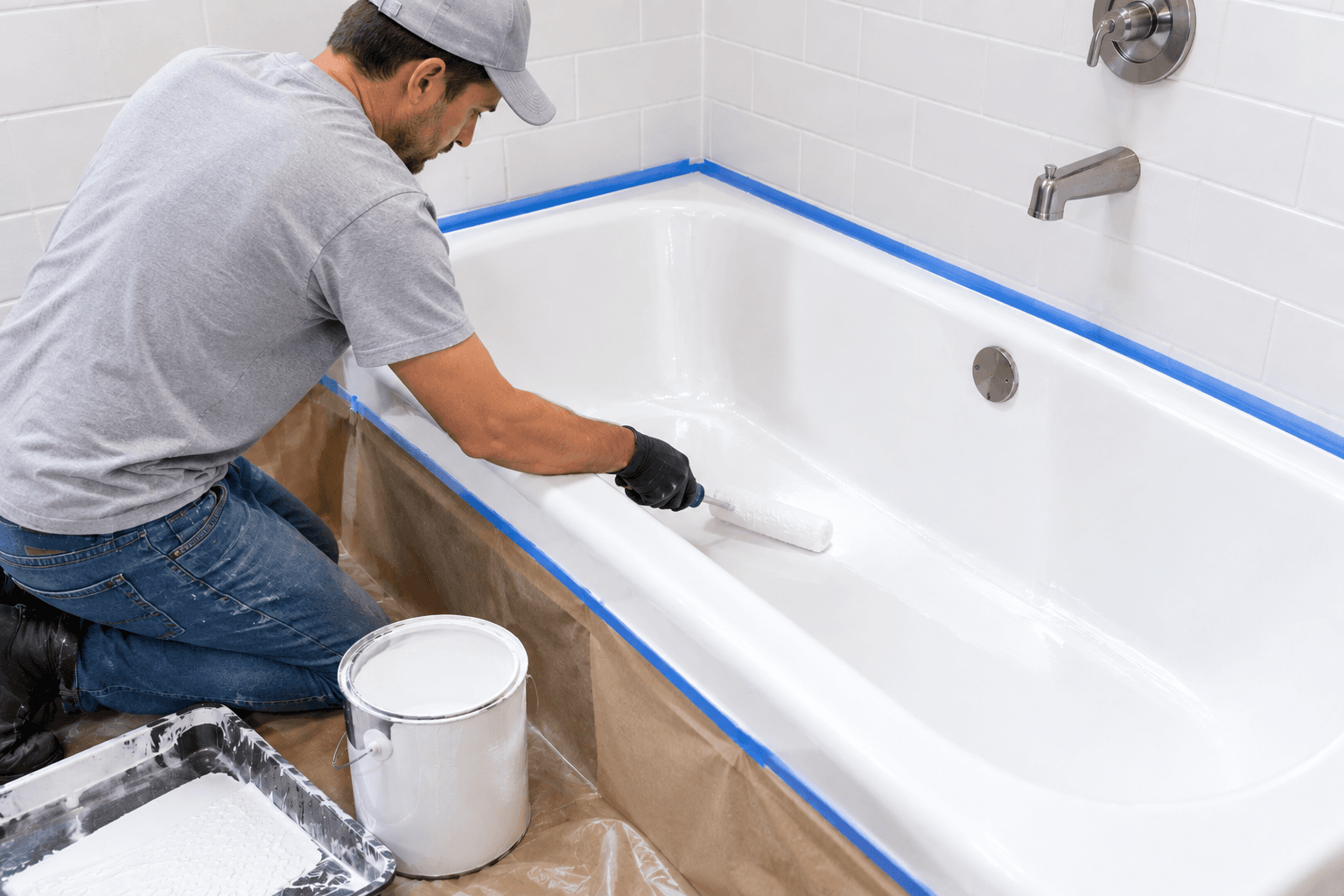
Refinishing bathtubs cost between $335 and $630 for most homes, with a national average near $480. That’s the figure every cost guide repeats.
Yet among all the figures on an estimate, this one explains the least.
For one thing, those guides share a source. Bob Vila credits Angi and HomeAdvisor. This Old House credits Angi, HomeGuide, and Fixr. New layout, same data. For another, a price only tells you what leaves your account today. It says nothing about how long the finish survives, or what the quote quietly left out.
So this works backward. Take a quote apart first, then divide it by years.
If you’ve already got a quote in hand, keep it nearby. It’ll make the next few sections far more useful.
Refinishing Bathtubs Cost, Line by Line: A Sample Quote Taken Apart
The table below is illustrative. It’s built from published ranges, not from a real contractor, so treat any dollar figure as a ballpark.
Line on the quote | What it usually covers | The question to ask |
Prep and etching | Cleaning, then sanding or chemically etching the glaze so the coating can grip | How do you strip or etch, and how is the room ventilated? |
Surface repairs | Chips, rust spots, dings. BestCompany puts these at $50 to $200 extra | Is repair included, or an add-on after I say yes? |
Caulk and masking | Old caulk out, drain and overflow taped, walls protected | Do you re-caulk afterward, and who pays? |
Coating | Primer plus finish coats | What’s the product, and how many coats? |
Labor | Often a day or less, per Bob Vila | Flat price or hourly? |
Cure time | The tub is off limits while it hardens, commonly 24 to 72 hours | Exactly when can we shower? |
Warranty | Length, and what voids it | What’s covered, in writing? |
Print that table or screenshot it. Having the seven questions on your phone while the contractor is standing in your bathroom beats trying to remember them.
A quote that just says “refinish tub, $300” isn’t lying. It’s silent on all seven rows. And the silence is where the surprises live.
The Price Isn’t the Cost: Dividing by Years
Installers commonly quote 10 to 15 years for professional work and 1 to 3 for a DIY kit. Our guide to how long reglazing lasts explains what drives that difference. Once you divide, refinishing bathtubs cost looks different.
Option | Upfront | Typical life | Roughly per year |
Professional refinish | About $480 average | 10 to 15 years | $32 to $48 |
DIY kit | $75 to $150 | 1 to 3 years | $25 to $150 |
New tub, installed | $1,400 to $10,500 | 25 years (assumed) | $56 to $420 |
The 25 years is my assumption, there for comparison only. The other figures come from the published ranges above and from This Old House and InchCalculator.
Read the DIY row twice. A kit looks cheapest on the receipt. It only wins if it lasts about three years. If it gives out sooner, the yearly cost overtakes the professional job in no time. And when a DIY coat fails, a pro will usually have to strip it before recoating. That’s extra labor in your next quote.
A kit can be a fair choice for a rental or a tub you plan to replace soon. It just isn’t the bargain the price tag suggests.
What Moves a Quote Up or Down
Size and shape. Clawfoot tubs run $500 to $1,300 according to Fixr, because the walls are deep and the outside often gets coated too.
Tub plus surround. Doing the shower walls at the same time lands around $500 to $1,200.
Material. Cast iron refinishing runs $300 to $650 per This Old House. Fiberglass can reach $1,000 per InchCalculator. The ranges overlap, so don’t read them as a price list.
Condition. Chips and rust add to the bill. A previous failed refinish does too, since it has to come off.
Why the Cheapest Quote Needs Questions
A bid far below your area’s range isn’t automatically a bad deal. But when refinishing bathtubs cost much less than the local norm, the gap has to come from somewhere.
Here’s why the prep line matters. CDC reported that 13 bathtub refinishers in 10 states died between 2000 and 2011 after breathing methylene chloride from paint strippers. NIOSH and OSHA later counted at least 14. Most of the victims were working in cramped bathrooms, with little airflow or a respirator that didn’t suit the job. CDC notes that a standard ceiling fan can’t clear that vapor from low inside the tub, and it points to alternatives like sanding and non-methylene-chloride strippers. (CDC/NIOSH)
That doesn’t make every low bid unsafe. It does mean safe prep and ventilation take time and equipment. Once margins get tight, ventilation and careful prep are the first things a contractor can skimp on.
So ask how they strip the old finish and how they protect the room. Get the warranty in writing. Then lay the bids side by side and judge each line, not the bottom number.
A good contractor won’t mind being asked how they handle fumes. If you get an eye-roll in response, you’ve learned what you needed to know.
When Refinishing Isn’t the Bargain
It’s dull or yellowed, but smooth. That’s often buildup, not damage. Try cleaning a plastic tub properly before paying anyone.
Rust has eaten through, or the tub flexes and cracks underfoot. A coating can’t hold a moving surface.
The floor feels soft or the room smells damp. Deal with hidden water damage first. A new finish over a leak just hides the evidence.
The seal around the tub is failing. Look at what’s behind the tile before you coat anything.
You’re gutting the bathroom anyway. Replacement makes sense then. Just know that pulling a tub means opening a wall, and drywall repair costs become their own line.
Still unsure? Get two or three quotes and compare them line by line. The differences usually show up fast.
Quick Answers
How does refinishing bathtubs cost compare with replacing?
Usually by a wide margin. $335 to $630 for a refinish against $1,400 to $10,500 for a new tub, before any wall or plumbing work.
How soon can I use the tub?
Most finishes need 24 to 72 hours to cure. Ask for the exact window in writing.
Can a tub that’s been refinished before be done again?
Often, but the old coating generally has to be sound or stripped first, and stripping adds cost.
Are the fumes a problem?
With any coating, yes. Follow the label: open windows, run a fan, and wear the respirator it specifies.
About Mubashir Yaqoob
Mubashir Yaqoob researches and writes practical home repair guides for Home Repair Manual, focused on translating technical roofing, plumbing, and maintenance information into clear advice for homeowners.
View all posts by Mubashir Yaqoob