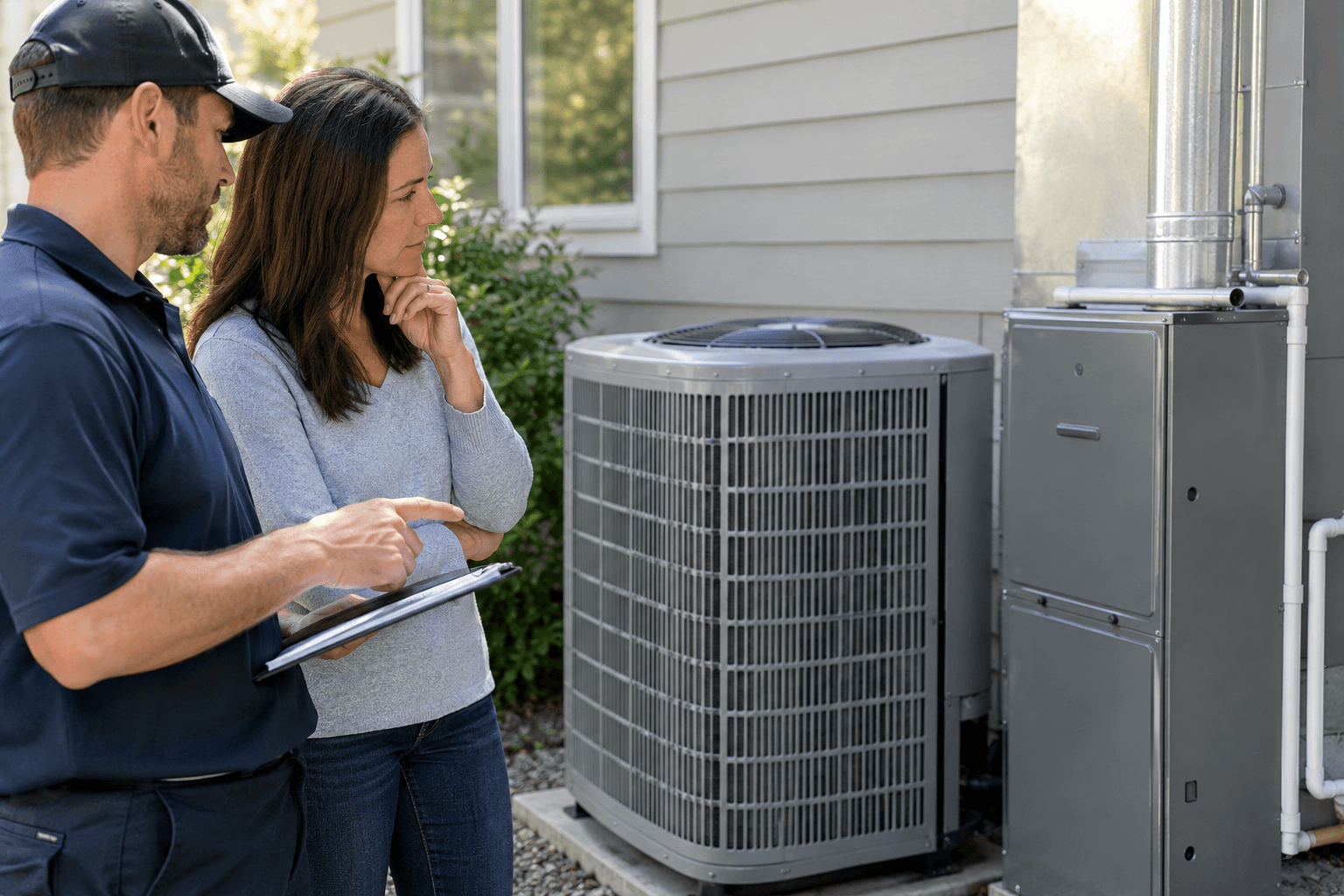
Most buying guides start with a list of system types and leave you to figure out which one fits your house. That's backward. How to choose heating and air conditioning system options that actually work for your home comes down to four specific questions, and the answers narrow the field before you compare a single brand or price.
This choice carries significantly more weight today due to recent regulatory shifts. The Department of Energy rolled out new SEER2 and HSPF2 testing standards in 2023, replacing the older SEER and HSPF numbers with ratings meant to reflect real-world performance, and minimum efficiency now varies by region instead of one national baseline. A system that looked fine a decade ago might not clear today's minimum at all.
Do You Already Have Ductwork?
Start here, because the answer rules things out fast. If your home has sound, existing ductwork, central air paired with a furnace or a ducted heat pump are both reasonable. No ductwork, which is common in older homes, additions, and converted spaces, changes the math entirely. You're choosing between installing ducts (expensive, invasive, sometimes not even physically practical) or going ductless with a mini-split system that delivers conditioned air through small wall or ceiling units instead. Retrofitting ductwork into a house that was never built for it often costs more than the equipment itself. That's the real reason ductless has become the go-to recommendation for additions and older homes.
What Does Your Winter Actually Demand?
Climate decides whether a heat pump alone can carry your heating load, or whether you need a furnace, or a dual fuel setup that uses both. Standard heat pumps lose efficiency as temperatures drop, and that used to rule them out for cold climates entirely.
Not anymore, at least not automatically. ENERGY STAR now certifies Cold Climate Heat Pumps built specifically to hold performance in low temperatures, requiring a coefficient of performance of at least 1.75 at 5°F. In plain terms, the unit still produces real heat in genuinely cold weather instead of leaning almost entirely on backup electric resistance heat, which is expensive to run. If you live somewhere with regular sub-freezing stretches, ask specifically whether a quoted heat pump carries the Cold Climate certification, not just a general ENERGY STAR label. In milder climates, a standard heat pump often doesn't need backup at all.
A dual fuel system, a heat pump paired with a gas furnace that only kicks in once temperatures drop below a set point, is worth asking about if your winters are cold but not brutal. You get the heat pump's efficiency most of the season and furnace output for the worst weeks.
How Big a System Do You Actually Need?
Here's the question almost everyone skips, and it's behind the single most expensive mistake in this whole process: oversizing. Size a system off square footage alone, or just match whatever got torn out, and you'll often end up with something bigger than the home needs. An oversized unit blasts the space to temperature fast, shuts off, then kicks back on again soon after. That pattern's called short-cycling, and it does more damage than people expect. Beyond wasted energy and faster wear on parts, short-cycling wrecks humidity control, since a system needs a full, uninterrupted run to actually pull moisture out of the air, not just drop the thermometer reading.
The right way to size equipment is a Manual J load calculation, an ACCA-developed method that factors in square footage, insulation, window area and orientation, ceiling height, air leakage, and local climate data. It's not a square-footage guess. Any contractor who won't run one, or who just copies the old unit's capacity onto a new quote, is skipping the one step that actually determines whether your new system performs well. Nothing else in this process affects comfort, efficiency, and equipment lifespan as much as getting this calculation right.
What Efficiency Level Fits the Budget?
As of the 2023 DOE standards, minimum efficiency now differs by region:
Equipment Type | North Region Minimum | South Region Minimum |
Central air conditioner (under 3.5 tons) | 13.4 SEER2 | 14.3 SEER2 |
Heat pump | 14.3 SEER2, 7.5 HSPF2 | 14.3 SEER2, 7.5 HSPF2 |
Ductless mini-split AC | 16 SEER2, 12 EER2 | 16 SEER2, 12 EER2 |
How to Find Your Region
The Department of Energy splits the United States into regulatory regions based on climate, and the line specifically impacts Central Air Conditioning minimums:
The North Region: Includes 30 states stretching from the Pacific Northwest, through the Midwest, and into New England (e.g., New York, Ohio, Illinois, Pennsylvania, Washington). If your winter requires heavy heating, you are likely in the North.
The South Region: Divided into the Southwest (Arizona, California, Nevada, New Mexico) and the Southeast (14 states including Texas, Florida, Georgia, and Maryland). If your summer cooling demands are exceptionally high, your state enforces the stricter 14.3 SEER2 baseline.
Going above these minimums costs more up front but lowers your running costs over the system's life, and whether that trade pays off depends on your local utility rates and the total operational hours the machinery accumulates over the course of a year. Incentives shift that math too. The Inflation Reduction Act currently offers a federal tax credit that can knock up to 30% off a qualifying heat pump installation, and plenty of utilities stack regional rebates on top of that. Before you write off a higher-efficiency system as too expensive, check what actually applies where you live. The real gap between baseline and high-efficiency equipment is often smaller than the sticker prices suggest.
System Type Breakdown: Choosing Your Match
System Type | Needs Ductwork | Best For | Typical Lifespan |
Furnace + central AC | Yes | Cold climates, existing ductwork | 15–20 years (furnace), 12–15 years (AC) |
Standard heat pump | Yes | Mild to moderate climates | 15 years |
Cold climate heat pump | Yes | Cold climates, no gas line available | 15 years |
Dual fuel (heat pump + furnace) | Yes | Cold climates wanting efficiency most of the year | 15–20 years |
Ductless mini-split | No | Additions, older homes, room-by-room zoning | 15–20 years |
Red Flags Worth Watching For When Getting Quotes
A few signals tell you whether a contractor is worth hiring:
No Manual J calculation offered. A quote based on square footage alone, or matched to the old unit's size, is a guess dressed up as a number.
Only one system type on the table. A contractor who doesn't ask about your ductwork, climate, or usage habits before recommending something specific isn't actually doing the sizing work.
Efficiency claims with no SEER2 or HSPF2 numbers attached. "High efficiency" is marketing language, not a spec.
No mention of current tax credits or rebates. Anyone actively selling this equipment should know what applies in your area right now.
Pressure to sign the same day. This is a 15-to-20-year decision. It can wait for a second quote.
The Long-Term Impact of Your Choice
The system you land on affects a lot more than the installation invoice. It shapes comfort for well over a decade, the realistic cost of routine maintenance going forward, and whether yearly upkeep stays predictable instead of turning into repeat repairs on equipment that was poorly matched to your home's structural requirements from the very beginning.
Once the system's installed, confirming its exact model and specs becomes your reference point for every future service call, warranty claim, or parts order. The same logic behind tracking how a home system's components age over its service life applies here too; it's what lets you plan ahead instead of reacting to a breakdown. Folding an annual HVAC check into a broader seasonal home inspection is the simplest way to make sure a well-chosen system actually delivers the lifespan it's rated for.
Common Questions
Are heat pumps more affordable to operate than gas furnaces?
It depends on climate. In mild to moderate regions, usually yes. In genuinely cold climates without a Cold Climate–certified unit, a standard heat pump can lean hard on backup electric resistance heat, which gets expensive fast, making a furnace or dual fuel setup the more practical pick overall.
Should my new system be bigger than the old one?
Not automatically, and often not at all. Homes get better insulated, windows get replaced, and a house's actual load shifts over time. Size off a Manual J calculation of the home as it is now, not the old unit's rated capacity.
Can a ductless mini-split handle a whole house, or just one room?
Both, depending on setup. A single-zone unit covers one room or small area. Multi-zone systems connect several indoor heads to one outdoor compressor and can realistically condition an entire home, especially one with no existing ductwork.
Does a higher SEER2 number always mean a lower energy bill?
Generally, yes, but how much you actually save depends on your climate, how many hours the system runs each year, and your utility's rate structure. A high-SEER2 system in a mild climate with light use can take years to pay back its higher upfront cost through savings alone.
How long should a new system last?
Furnaces typically run 15 to 20 years, air conditioners and heat pumps around 15. Actual lifespan leans heavily on sizing accuracy, installation quality, and whether maintenance actually happens, not just the equipment's rated specs.
About Mubashir Yaqoob
Mubashir Yaqoob researches and writes practical home repair guides for Home Repair Manual, focused on translating technical roofing, plumbing, and maintenance information into clear advice for homeowners.
View all posts by Mubashir Yaqoob