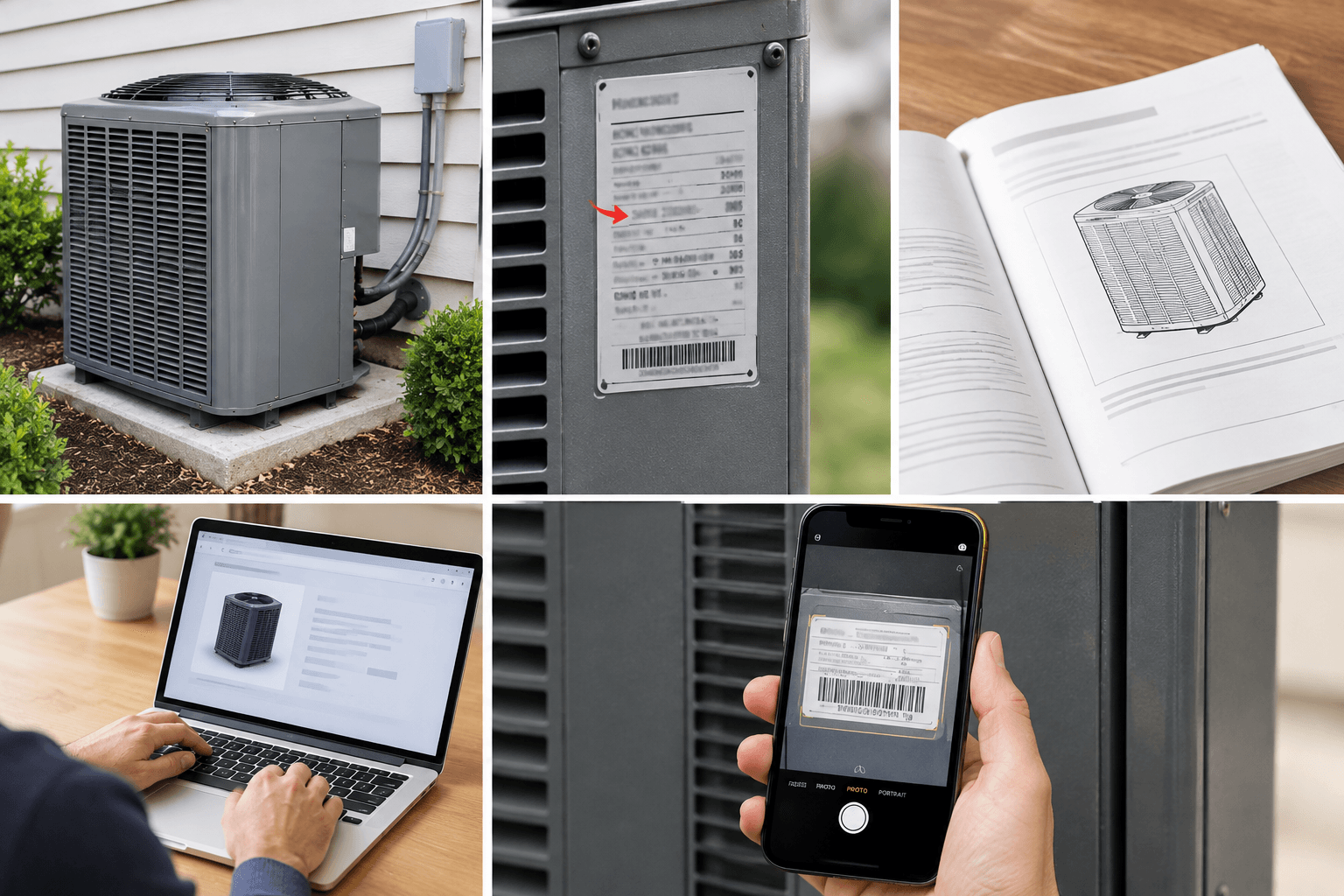
Ordering the wrong capacitor, filing a warranty claim that gets rejected, or pricing a repair off the wrong tonnage all trace back to the same cause: an unverified model number. HVAC equipment model number verification methods range from glancing at a sticker to pulling old permit records, and they are not interchangeable. Some are reliable enough to act on immediately. Others are a starting point that still needs confirming.
This guide ranks six real verification methods from most to least direct. Treat them as a sequence, not a menu: try them in order, and only move to the next one when the previous one genuinely fails.
Here's how all six HVAC equipment model number verification methods stack up at a glance.
Approach | How Much to Trust It | When to Use It |
1. The tag on the unit | Highest | Confirming exact model and serial number directly from the unit |
2. Manufacturer lookup or registration portal | Very high | Verifying a hard-to-read number, or checking a previously registered unit |
3. AHRI Directory lookup | Highest, for matched systems specifically | Confirming an outdoor and indoor unit are a certified matched pair |
4. Independent serial/age decoder database | Moderate | Narrowing down manufacture date when the format is unclear |
5. Original installation paperwork or permits | Moderate to high | Equipment in a home you didn't personally have installed |
6. Professional technician verification | High, but costs a service call | Missing or illegible nameplate with no paperwork available |
Six Ways to Confirm It, Side by Side
1. Start With the Tag Already on the Unit
Every piece of HVAC equipment ships with a metal or high-temperature adhesive nameplate listing the model number, serial number, and often the tonnage, voltage, and refrigerant type. This is the most reliable source, since it comes directly from the manufacturer at assembly.
Where to look: inside a furnace's front access panel, on the side or back of an outdoor condenser or heat pump near the electrical connections, or inside an air handler's cabinet near the coil.
A worn or faded tag causes more misreads than a missing one. Zero versus the letter O, one versus capital I, five versus S, these look nearly identical on a scratched or sun-bleached label. Photograph anything ambiguous and zoom in digitally rather than guessing from memory. If the tag is painted over or missing entirely, don't guess based on a similar-looking unit. Move to the next method.
2. Go Straight to the Manufacturer
The fastest real first move is searching the model number online. It sounds obvious, but it often lands you directly on the manufacturer's own spec sheet in seconds, confirming capacity and configuration with no login required.
Beyond that, most major manufacturers, Goodman, Trane, Carrier, and others, offer an official lookup or registration portal that checks a model and serial number directly against their own database. This is more authoritative than a search result, since it confirms the data against the source. It's most useful when you have a partial or hard-to-read number from the tag, or when the unit was registered previously and the manufacturer has it on file.
3. Check the AHRI Directory for Matched Systems
If you're dealing with a split system, an outdoor condenser or heat pump paired with an indoor coil or air handler, there's a more authoritative check than a manufacturer portal for one specific question: is this combination actually a certified matched pair? The Air-Conditioning, Heating, and Refrigeration Institute maintains the AHRI Directory, searchable by AHRI Certified Reference Number at ahrinet.org, and it's the database HERS raters, code inspectors, and most utility rebate programs actually check.
A manufacturer portal confirms what a single unit is. AHRI confirms whether your specific indoor and outdoor combination was tested and certified together at its rated efficiency. A mismatched pairing, say an outdoor unit swapped during a past repair without updating the indoor coil, can still run, but it won't pass certification for a rebate or code inspection. If a rebate, home sale, or code compliance is the reason you're verifying equipment, this is the step that actually answers the question.
4. Decoder Sites: Good for a Date, Not Much Else
A small number of independent sites decode manufacture dates from serial numbers across many HVAC brands at once, useful since date-coding formats vary by manufacturer and even by product line. One example is the Building Intelligence Center, a free reference compiling serial number date formats across HVAC, water heater, and other appliance brands. Treat these as a cross-reference, not a final answer. Their published examples are illustrative and may not match your exact format letter for letter, and they can't confirm matched-pair certification the way AHRI does.
5. The Paper Trail From Move-In or Installation Day
An installation invoice, a building permit, or a contract from the installing company typically lists the exact model and serial number installed. This matters most for equipment you didn't personally have installed, such as a system in a home you just bought, where the tag might be inaccessible or you want to confirm nothing's been swapped since installation. Local permit offices often keep these records for years and can be contacted directly.
6. Bringing In a Technician as the Fallback
When the tag is missing, the installer is out of business, and no paperwork exists, a licensed technician can often identify a unit by its physical configuration and internal components, sometimes finding a hidden secondary tag. This is the most reliable fallback once everything above is exhausted, but it comes with a service call fee, so try the rest first.
What Those Characters Are Actually Encoding
Verifying the number is half the job. Manufacturers encode real information into that string: equipment type, nominal capacity (tonnage or BTUs), efficiency tier, sometimes refrigerant type. A segment like "036" partway through a residential model number often correlates to 36,000 BTUs, or three tons, though the exact position varies by brand. This is why checking the manufacturer's documentation still matters even after the number is confirmed. Decoding it from memory or a generic guide risks misreading a format specific to one brand.
When Two Sources Disagree
A nameplate might list a number a generic decoder can't parse, or a permit might show an older model than what's currently installed if equipment was swapped without updating the paperwork.
When that happens, the physical tag wins over an independent decoder, and the manufacturer's own lookup wins over both for identity questions. For a matched-pair certification question specifically, AHRI is the tiebreaker regardless of what a manufacturer portal or decoder suggests, since it's the one source built to answer exactly that. If a decoded result seems inconsistent with the unit in front of you, a tonnage that's obviously wrong for the space it's cooling, trust what's on the unit and verify through the manufacturer or AHRI before ordering parts or filing a claim.
Why HVAC Equipment Model Number Verification Methods Are Worth the Extra Effort
A correct model number is what separates a repair that goes smoothly from one that doesn't. It determines whether a warranty claim is honored, whether a parts supplier ships the right capacitor or control board, and whether a furnace tune-up is being performed on a unit the technician has actually identified correctly. The same problem shows up elsewhere: locating a water softener's manual starts with the identical first step, finding the model and serial number before anything else.
Age verification specifically matters for repair-versus-replace decisions. The logic behind how long a water softener's components are expected to last applies directly here: a confirmed age makes that estimate meaningful instead of a guess. This comes up most in older homes where equipment history gets lost over time, exactly when the later methods above become necessary.
Common Questions
Which method should I try first in almost every case?
The tag on the unit. It's free, immediate, and comes straight from the manufacturer. Only move down the list if it's missing, damaged, or illegible.
Can I trust a sticker that looks reprinted or replaced?
Be cautious. Cross-check it against the manufacturer's records or the installation paperwork before relying on it for a parts order or warranty claim.
Do model numbers ever get reused across equipment generations?
Rarely the exact same string, but very similar numbers across years or regional variants do exist, which is exactly why a direct manufacturer check matters for anything parts- or warranty-related.
Is the serial number or model number more important to a technician?
Both, for different reasons. The model number identifies configuration and capacity; the serial number pins down manufacture date and sometimes specific component revisions.
Do I need to check AHRI if I'm not pursuing a rebate?
Not urgently, but it's worth a quick check if either half of a split system was ever replaced individually, since that's the most common way a matched pair becomes unmatched without anyone realizing it.
About Mubashir Yaqoob
Mubashir Yaqoob researches and writes practical home repair guides for Home Repair Manual, focused on translating technical roofing, plumbing, and maintenance information into clear advice for homeowners.
View all posts by Mubashir Yaqoob