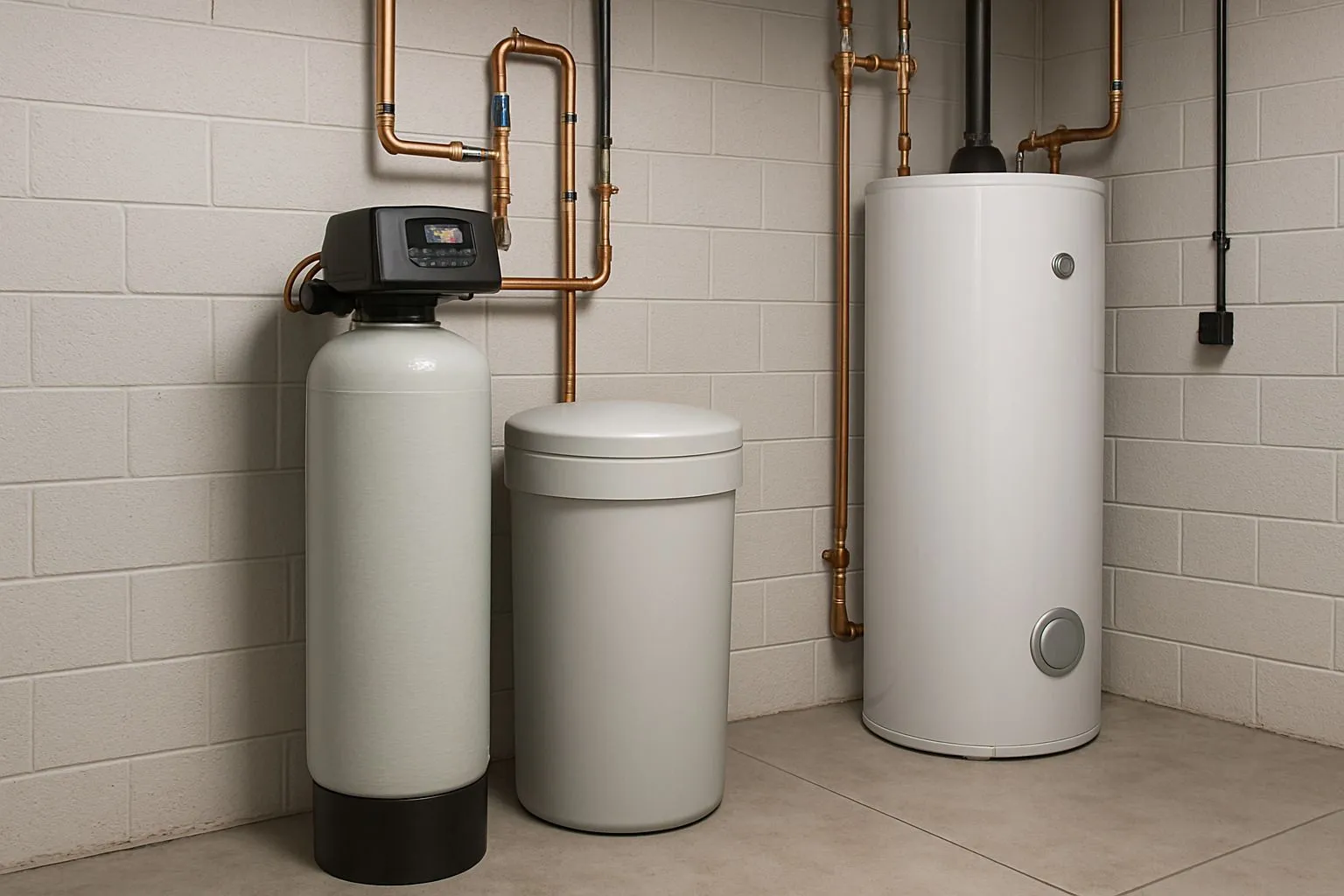
Ask three installers how long a softener lasts and you'll get the same answer: 10 to 15 years. That's a fair number for a salt-based unit, and it's nearly useless on its own. The average life of a water softener is mostly the life of its resin, because that's the part that quits first. The valve and the tanks usually keep going.
So the better question is which part of your unit is likely to fail, and when. That's what this covers, along with how to figure out the age of a softener you inherited and how to choose between a repair and a new one.
The Average Life of a Water Softener Depends on Which Part You Mean
Installers quote different ranges for each component, and the sources don't fully agree. Treat these as planning figures, not promises.
Part | Typical service life | What usually ends it |
Resin bed | 8 to 15 years | Chlorine damage, iron fouling, years of hard water |
Control valve (control head) | 10 to 25 years, depending on brand | Worn seals, motor or circuit board failure |
Mineral tank | 20 to 30 years or more | Physical damage; rarely fails on its own |
Brine tank | 15 to 20 years or more | Cracks from age or impact |
If the resin is worn out but the tanks and valve are fine, you can often buy back several years for a fraction of the cost of a new unit. Keep that in mind when you get to the repair-or-replace section below.
A Softener's Life in Four Stages
Years 1 to 5
A softener this young should be nearly invisible. Trouble at this stage usually comes from setup, not wear: a hardness setting nobody adjusted, a bypass valve left open after service, a badly routed drain line. Start with a troubleshooting guide before you blame the machine.
Years 5 to 10
The wear starts here and you won't see it. Resin beads lose capacity a little at a time, valve seals harden, and the unit may start regenerating more often or burning more salt. Small habits matter most in this stretch, and a simple maintenance checklist is what separates a healthy year 10 from a tired one.
Years 10 to 15
Something usually needs attention now: weak resin, a valve that regenerates at odd times, or sounds that weren't there before. Before you spend anything, learn which softener noises are normal and which aren't.
Past 15
Plenty of units run this long, especially on clean city water. But several parts are usually near the end together, and older timer-based controllers regenerate on a fixed schedule whether the water needs it or not. Newer demand-initiated units regenerate based on actual use. A 15-year-old softener that still works is fine. Just start budgeting for its replacement.
Chlorine, Iron, and Hard Water: The Three Things That Age Resin
Chlorine
Chlorine and chloramine attack the crosslinks that hold resin beads together, and the beads slowly swell and break down. A trade-press piece in Water World notes that some manufacturers rate standard 8 percent gel resin at 10 to 15 years, but that as little as 2 ppm of residual chlorine can cut that roughly in half. Most city supplies run lower than that, so the damage is slower, but it adds up. A carbon pre-filter ahead of the softener is the usual protection, and higher-crosslink 10 percent resin lasts longer in chlorinated water. Your utility's annual water quality report will tell you what disinfectant it uses.
Iron
On well water, iron is the bigger threat. It coats the beads and blocks them from trading minerals. Many installers suggest treating iron before it reaches the softener once levels climb past about 2 ppm. USGS notes that groundwater chemistry stays fairly stable over time, so one solid lab test of your well tells you a lot.
Hardness and Household Size
The USGS calls water above 180 mg/L "very hard," which works out to about 10.5 grains per gallon. Here's why that matters. Say a household uses 250 gallons a day. At 15 grains per gallon, that's 3,750 grains of hardness passing through the resin every day, so a 32,000-grain softener fills up in roughly eight days on paper. At 5 grains per gallon, the same household takes about 25 days. Same machine, about three times the workload. Those are illustrative numbers, but they show why hard water and big families age a softener faster.
Get Your Own Numbers Before You Decide
The average life of a water softener assumes typical water, and yours may not be typical. Two documents give you real numbers. On city water, your utility publishes an annual water quality report (often called a Consumer Confidence Report) that names the disinfectant it uses and, in many cases, lists hardness in mg/L. Divide that figure by 17.1 to get grains per gallon. On a well, a lab test covering hardness, iron, and manganese costs far less than a new softener, and it tells you whether your resin has an easy life or a hard one. Also pay attention to how often the regeneration cycle runs. A softener that regenerates much more often than it used to is telling you its resin capacity is shrinking.
Salt-Based, Dual-Tank, or Salt-Free?
Everything above applies to salt-based ion-exchange softeners, which most homes have. Dual-tank units, where one tank works while the other regenerates, are often quoted at 15 to 20 years. Salt-free conditioners use a different process and don't remove hardness minerals the same way, so their lifespan and results aren't comparable. For those, go by the manufacturer's warranty and documented performance, not a generic number.
How to Find Out How Old Your Softener Is
If the softener came with the house, its age is the most important thing you don't know. Try these in order:
Look for a serial number and date code on the label of the control head.
Check the mineral and brine tanks for date stamps.
Look for a receipt, warranty card, or service tag near the unit or in the home records.
Ask the seller, the previous owner, or the installer named on a service sticker.
Once you have the model and serial number, finding the manual for your exact unit usually explains how that brand formats its date codes. If nothing turns up, assume it's older than it looks. That's the same rule of thumb for any aging system, as covered in plumbing issues in older homes.
Rebed, Repair, or Replace
There are three realistic paths, and the right one depends on which part failed.
Rebedding means replacing the resin and keeping the tanks and valve. Resin for a standard tank is commonly quoted at roughly $80 to $300 depending on volume and crosslink rating, and a pro typically adds a couple hundred dollars in labor. It makes sense when hard water has returned, salt use is normal, and the valve and tanks are sound.
Repairing the valve covers seals, a motor, or a circuit board. It's fine on a middle-aged unit, but it's also where money quietly disappears on one that's near the end.
Replacing the unit makes sense when the valve and resin are both failing, repairs keep repeating, or the softener is well past 15 years. A newer demand-initiated model also uses less salt and water.
A common rule of thumb: if a repair quote nears half the price of a new unit, replace it, especially past year 12. Get two quotes and ask each installer exactly which part failed. The average life of a water softener is a planning tool, and a good installer will tell you straight whether your unit is worth saving.
What Buys You Extra Years
Protect the resin. A carbon pre-filter for chlorine or iron treatment for a well does more than anything else.
Keep salt levels up and break up bridges before they starve the resin of brine.
Use resin cleaner as the manufacturer directs. It helps with iron, but it can't undo chlorine damage.
Re-check the hardness setting after any change in your water or household.
Keep the unit away from freezing temperatures, which crack valves and tanks.
Quick Questions
Does a warranty tell me how long it will last?
Not really. Warranties describe defect coverage, and they're often longer on tanks than on the control head. Read what voids them, such as skipped maintenance.
Does an old softener cost more to run even if it works?
Often, yes. Older timer-based units can waste salt and water compared to newer demand-initiated ones.
Is a used softener worth buying?
Only if you can confirm its age and the condition of the resin and valve. Without that, you're buying the same uncertainty with no warranty.
About Mubashir Yaqoob
Mubashir Yaqoob researches and writes practical home repair guides for Home Repair Manual, focused on translating technical roofing, plumbing, and maintenance information into clear advice for homeowners.
View all posts by Mubashir Yaqoob