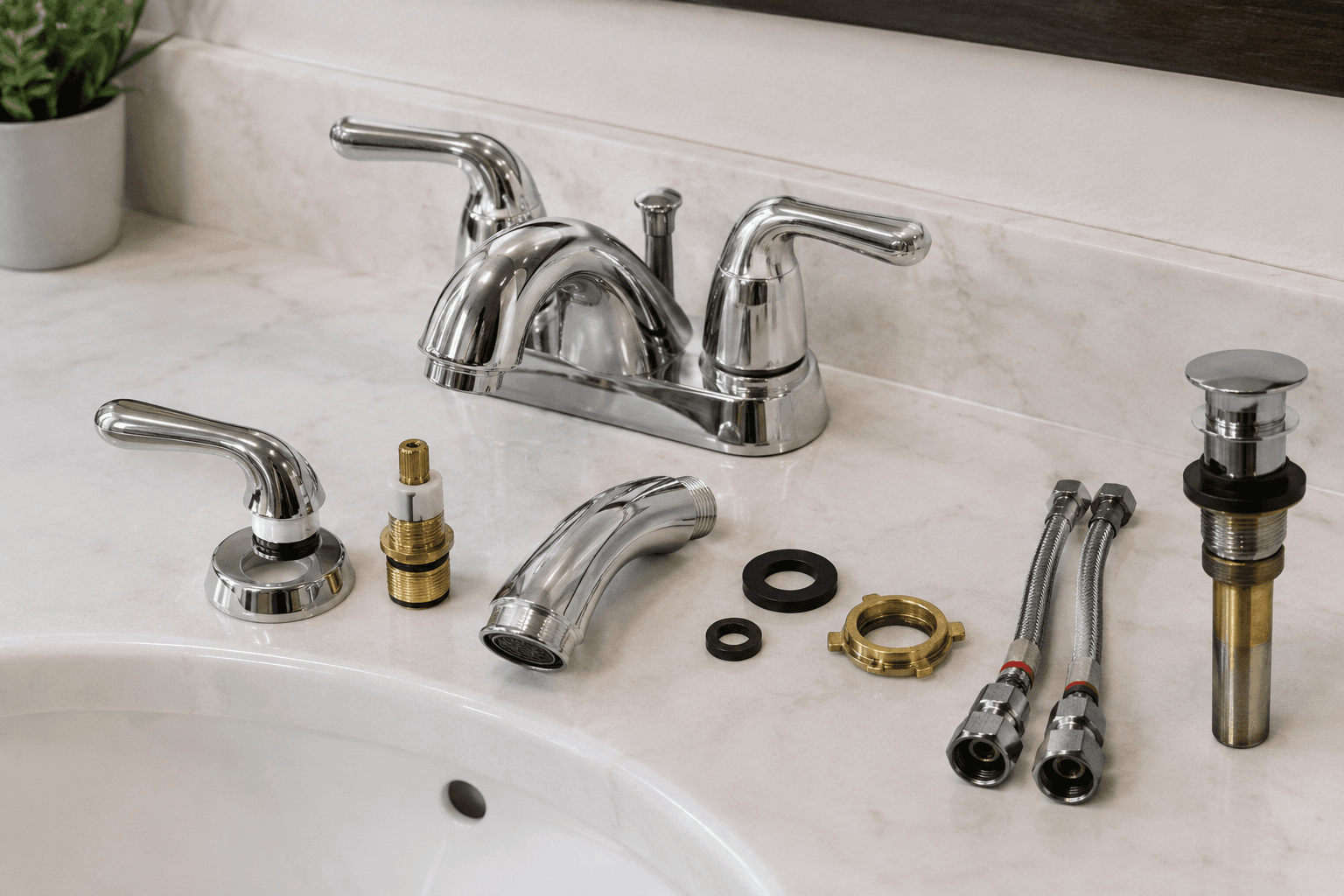
A plumber's invoice for a dripping faucet routinely runs past $100, mostly for a part that costs somewhere between $10 and $40 at the hardware store. The gap isn't labor skill. It's that most people walk into the store without knowing what to ask for and walk out with the wrong box.
Fix that first problem and the second one solves itself. Learn bathroom faucet parts names, figure out which one is actually failing, and tracking down the matching bathroom faucet repair parts stops being a guessing game.
From Handle to Shutoff: Bathroom Faucet Parts Names
Follow the water from the handle down to the pipes, and these eight parts make a lot more sense than they would memorize off a list.
1. Handle
The piece you actually touch. A single handle that lifts and rotates is controlling temperature and flow together in one motion. Two separate handles are doing that job independently, one for hot, one for cold, which is usually your first clue about what's hiding underneath.
2. Escutcheon Plate
The flat decorative plate sitting under the handle, covering the mounting holes drilled into the sink deck. Purely cosmetic, but it's also what you'll be matching for finish if you ever replace a handle and don't want a mismatched faucet staring back at you every morning.
3. Cartridge or Valve
The part doing the actual work. This is the internal mechanism that opens and closes to let water through when you move the handle, and it's the single component most responsible for a faucet that won't stop dripping. Everything else on this list is secondary to getting this one right.
4. Spout
The piece water visibly flows out of. Simple in concept, but spout design is where compression, cartridge, ball, and ceramic disc faucets start to look genuinely different from each other on the outside.
5. Aerator
A small mesh disc screwed into the very tip of the spout, easy to forget exists until something goes wrong. Hard water minerals clog this more than any other part on the faucet, and a weak, sputtering stream usually gets blamed on the cartridge or the pipes long before anyone thinks to check here first. Worth checking first, honestly. It takes thirty seconds to unscrew and rinse under the tap.
6. Supply Lines
Flexible hoses running from the faucet down to a pair of shutoff valves under the sink. These carry hot and cold water separately right up until they meet inside the faucet body.
7. Shutoff Valves
The valves you turn before starting literally any repair on this list. On an older fixture, these can be stiff or even seized from years of never being touched, which is its own small project worth knowing about before an emergency forces the issue.
8. O-Rings and Washers
Small rubber seals scattered throughout the assembly, aging and cracking independently of the cartridge. A leak pooling around the base of the faucet, rather than dripping from the spout, almost always points here instead.
In practice, almost every bathroom faucet complaint traces back to just two of these eight: a clogged aerator or a worn cartridge. Knowing the rest mostly helps you describe the problem accurately, whether that's to yourself while standing in a store aisle or to someone behind a counter.
Does Your Faucet Twist, Lift, or Have Two Separate Handles?
How your faucet physically behaves tells you more than its brand name does, and it determines which repair parts actually apply.
A handle that lifts and rotates smoothly in any direction is almost certainly a cartridge, ball, or ceramic disc design, the kind built around one internal mechanism rather than loose individual parts. A handle that only turns, with some resistance as it closes, especially paired with a second handle doing the same job for the other temperature, is usually an older compression faucet. These use a stem pressing a rubber washer against a seat, and they need separate washers, seats, and springs rather than one replaceable cartridge, which is why their repair kits tend to come packed with several small loose pieces instead of a single part.
Ball faucets, common on older single-handle kitchen and bath fixtures, work through a rotating ball riding on a spring-loaded seat, and their kits look similar to a compression faucet's: several small components rather than one. Ceramic disc faucets sit at the other end of the spectrum, using two hard discs sliding against each other. They tend to outlast every other type with fewer leaks along the way, though replacing that disc cartridge costs more than a standard one when it finally does wear out.
Getting this right before you shop is what keeps you from coming home with a kit that simply doesn't fit what's under your handle.
How to Buy the Right Faucet Repair Parts the First Time
Here's the part that actually trips people up, more than the repair itself ever does: faucet cartridges are proprietary. A Moen cartridge won't fit a Delta faucet. Worse, different product lines inside the same brand frequently use cartridges that look nearly identical on the shelf but aren't interchangeable, sold under part numbers that differ by a digit or two.
Confirm the brand and exact model before you buy anything. That information is usually stamped somewhere on the faucet body or handle, and a model can often be traced through installation paperwork or by matching the faucet's look against a manufacturer's current and discontinued listings online. If you've already pulled the old cartridge out, bring it with you or photograph any numbers stamped on it. That single photo is the most reliable way to walk out with the right part on the first trip.
Two different categories of bathroom faucet repair parts sit on the shelf waiting for you. OEM-specific cartridges are matched exactly to one brand and model. Universal repair kits, often sold under names like Danco, are built to fit a range of older or compression-style faucets using washers, O-rings, and seats instead of one proprietary cartridge. For a modern single-handle faucet, the exact OEM part is almost always correct. For an older compression or ball-type faucet, a universal kit is usually the cheaper, more practical choice.
The Real Math: Parts Versus a Service Call
Approach | Typical Cost | What It Fixes |
Aerator replacement | Under $10 | Most sputtering or low-flow complaints |
OEM cartridge, brand-matched | $10 to $40 | Most single-handle drips |
Universal repair kit (washers, O-rings, seats) | $10 to $20 | Compression and ball-type faucets |
Professional service call | $100 to $250+ | The same fix, done by someone else |
Parts rarely explain a high repair bill on their own. A technician's time and a diagnostic visit usually do. Nail down the bathroom faucet parts names involved in your specific drip, come home with the right bathroom faucet repair parts, and the entire job often costs less than what a plumber would charge just to walk through the door.
Where This Goes Sideways
A handful of avoidable missteps account for most second trips to the store:
Buying a universal kit for a modern cartridge faucet. It physically won't fit, and the return trip burns more time than getting it right the first time would have.
Matching function but ignoring finish. A technically correct handle or escutcheon in the wrong finish is a part you'll be annoyed by every time you walk into the bathroom.
Skipping the specialty puller tool some cartridges require. Forcing one out with pliers can damage the valve body, which turns a cheap parts repair into a full faucet replacement.
Forgetting to shut off water first. Obvious to say, common to forget, especially when the shutoff valves themselves haven't been touched in years and feel stiff.
Beyond This One Faucet
The habit at the center of all this, confirm the exact part before you buy, shows up constantly outside the bathroom too. Verifying an HVAC system's model number before ordering a component follows the same logic, and getting it wrong wastes the same kind of time regardless of which system you're working on. If a faucet issue turns out to be about pressure rather than a worn part, a two-minute pressure test rules that out before you spend a dollar on parts that were never the actual problem.
Faucet wear also tends to show up alongside other aging fixtures in the same house, a pattern covered in more depth in common plumbing issues in older homes. Folding a faucet check into a broader seasonal home inspection and a general home maintenance routine means a slow drip gets caught and fixed long before it turns into a bigger water bill.
Common Questions
How do I tell a cartridge faucet from a compression one without taking it apart?
A handle that lifts and rotates freely in any direction is almost always cartridge, ball, or ceramic disc. One that only turns, with some resistance near the end, especially paired with a second handle, points to an older compression design.
Can I just use a universal repair kit on a newer faucet to save a few dollars?
Not reliably. Modern cartridge faucets are built around one specific proprietary part, and a universal kit's washers and seats generally won't substitute for it. Whatever you save upfront tends to disappear the moment you need a second trip to the store.
Is it worth grabbing extra O-rings and washers even if I only need one today?
Usually, yes. They're cheap, and the same faucet often develops a second small leak within a year or two of the first repair, especially on an older fixture where several seals are aging at roughly the same rate.
Where's the easiest place to find my faucet's exact model number?
Check the underside of the handle, the base of the spout, or any paperwork left over from installation. If none of that turns up anything, a close-up photo sent to the manufacturer's customer support line is usually enough for them to identify it from their end.
About Mubashir Yaqoob
Mubashir Yaqoob researches and writes practical home repair guides for Home Repair Manual, focused on translating technical roofing, plumbing, and maintenance information into clear advice for homeowners.
View all posts by Mubashir Yaqoob