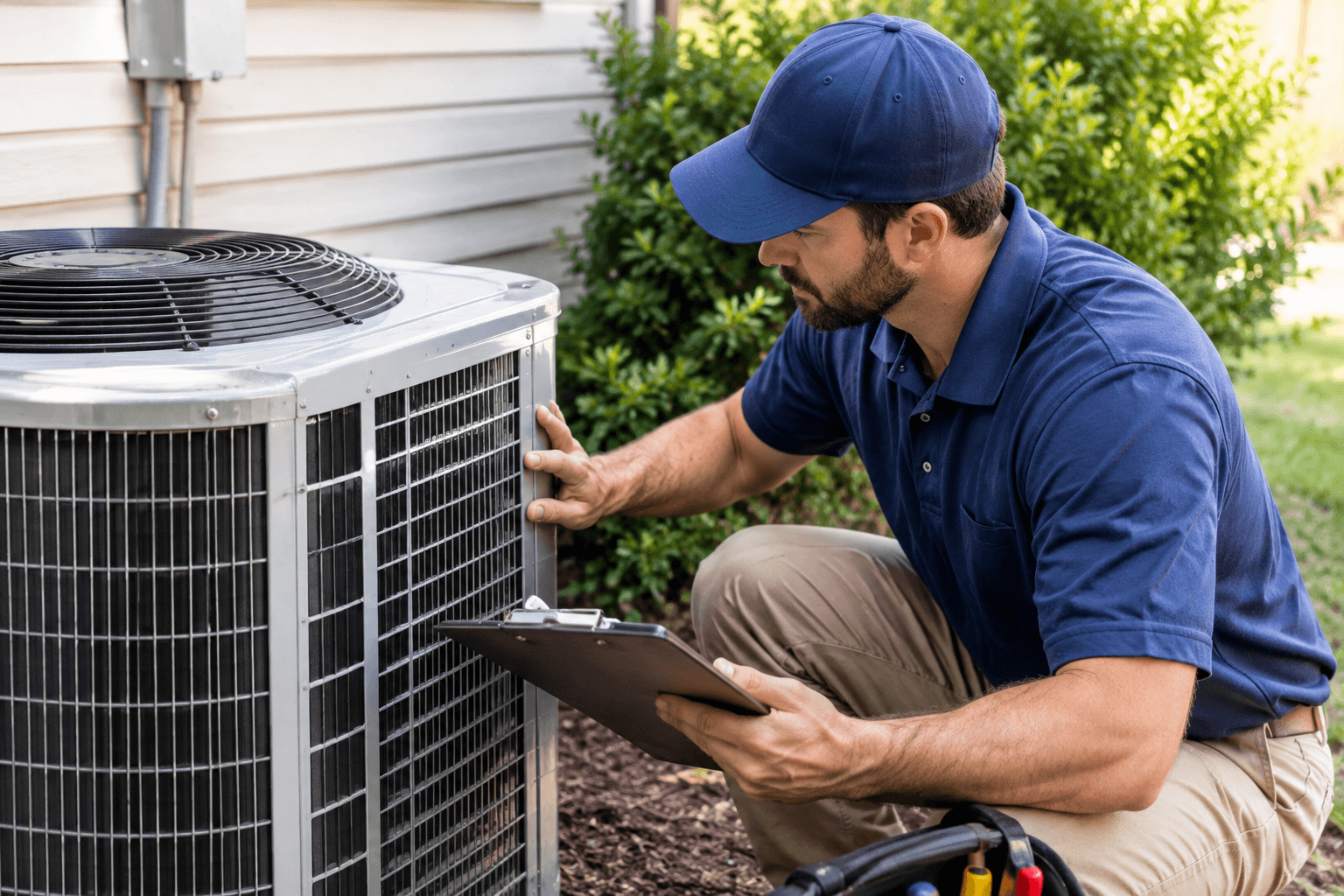
Your AC has broken down again; the technician is holding a quote, and everyone you ask has a different rule. Replace at 10 years. Replace at 15. Never replace a working system. It's no wonder people freeze.
Deciding when to replace AC unit equipment comes down to four things: age, repair cost, refrigerant type, and how the system behaves day to day. This guide turns those into a simple scorecard you can run in ten minutes, with real homeowner patterns and honest limits on every rule.
General guidance for central air systems. Local market conditions, equipment availability, and environmental regulations fluctuate, so securing official documentation from local HVAC specialists is vital.
When to Replace AC Unit: The Short Answer
Run these three quick tests first. If two of them say replace, move on to the scorecard.
Test | Replace if | Repair if |
Age | 12 to 15 years or older, with a major part failing | Under 10 years, with a minor part failing |
Repair cost | The quote is more than half the price of a new system | The quote is a small fraction of it |
Refrigerant | Your unit uses R-22 and has a leak | It uses a current refrigerant and holds its charge |
Age Tells You Less Than You Think
Most sources put central AC life at 10 to 15 years. A few say 15 to 20 with good care. Both can be true. Climate, run time, installation quality, and maintenance all move the number. Not sure how old yours is? The nameplate or serial number usually shows the manufacture date.
Age | Usual call |
Under 8 years | Repair, and check the warranty first |
8 to 12 years | Repair minor faults, budget for replacement |
12 to 15 years | Compare repair against replacement every time |
Over 15 years | Replace if a major part fails |
Minor electrical component faults or blower issues in relatively new hardware warrant straightforward maintenance. On an older unit, a failed compressor or coil is where replacement starts to win.
The Repair-or-Replace Scorecard
Give yourself one point for every yes.
Question | Point |
Is the system 12 or more years old? | 1 |
Has it needed two or more repairs in the past two years? | 1 |
Is the current quote more than half the cost of a new system? | 1 |
Does it use R-22 refrigerant? | 1 |
Is cooling uneven, or is the house humid, even after maintenance? | 1 |
Have energy bills climbed with no other change? | 1 |
Is the failing part a compressor or coil outside its warranty? | 1 |
Score 0 to 2: repair and keep going. Score 3 to 4: get a replacement quote and compare. Score 5 to 7: replacement is probably the better buy.
Four quick scenarios:
Situation | Likely call |
Nine years old, failed capacitor, $250 quote | Repair |
Thirteen years old, R-22 leak, $1,400 quote | Replace |
Fourteen years old, compressor under parts warranty | Repair if labor is modest, but get a second quote |
Sixteen years old, still cooling, bills rising | Plan a spring replacement |
The Money Math: Two Rules and Their Blind Spots
Two rules appear everywhere. Both help with when to replace AC unit decisions, and both have blind spots.
The 50 percent rule: if the repair costs more than half the price of a comparable new system, replace.
The $5,000 rule: multiply the unit's age by the repair quote. If the result tops $5,000, lean toward replacement.
Try it. A $300 fix on a 12-year-old system scores 3,600, so repair. A $900 fix on a 14-year-old system scores 12,600, so replace.
The rules ignore three things: warranty coverage, whether the repair is a one-off, and how cheap the failed part really is. Other guides set different lines, from $1,500 on an eight-to-ten-year-old system to $3,000 on a 15-year-old one. Treat any single number as a prompt for a second quote, not a verdict.
The Refrigerant Question
Systems that use R-22, often called Freon, are old by definition. New equipment stopped using it in 2010, and under the EPA phase-out its production and import ended in 2020. What's left is recycled or stockpiled and pricey.
If an R-22 system develops a leak outside warranty, repairing and recharging often throws good money after bad. That's usually the clearest single trigger to replace. You can check your unit's refrigerant on the nameplate, and our model number guide shows how to read it.
Warning Signs the Unit Is Near the End
Repairs keep coming, and two or more calls a year is a common marker.
Some rooms stay warm while others are fine.
The system struggles to manage indoor moisture, leaving rooms feeling heavily muggy.
Monthly utility expenses consistently increase despite normal operation settings.
Noises get louder, especially humming or squealing near the compressor.
It takes more than half an hour to bring a room down, as one engineer put it.
It short cycles, starting and stopping in minutes, which can also mean it's oversized.
One sign alone rarely means replacement. Two or three together do. If your system is showing these warnings and you aren't sure whether it has completely failed yet, our diagnostic guide on how to know if your AC is broken walks you through a few rapid checks. Water around the indoor unit is another flag, and our guide to an AC vent leaking water covers the usual causes.
What Homeowners Report
Forum threads show how people actually settle the question of when to replace AC unit equipment. The details are anecdotal, and many threads are old, so ignore the prices and keep the patterns.
Check the cheap parts first. Posters repeatedly note that a failed capacitor can cost far less than the repair quote suggests, and several said a tech blamed the compressor when the real culprit was a small part.
Get a second quote. A common line was that if the repair quote tops half the price of a new unit, replace it, but only after a second opinion confirms the diagnosis.
Check the warranty. Compressor parts are often covered for years, which can leave only labor to pay.
Distrust the pitch, both ways. Some owners felt pushed toward replacement at 15 years, while others said patching a unit that old just buys one more summer.
Comfort counts. One owner who swapped a decades-old unit for a variable-speed system reported quieter, more even cooling. Another with an 11-year-old working system and a five-figure quote chose to repair.
Before You Buy: Avoid Replacement Mistakes
Get a sizing calculation. Oversized units start and stop in short bursts, while undersized ones run for 30 minutes or more and wear out.
Check the ducts. A new unit can't fix leaky or undersized ductwork.
Match the system. The indoor coil and outdoor unit should be designed to work together.
Get two or three written quotes. Our guide on what to know before you call an HVAC contractor helps you compare them.
Time it well. The worst time to replace is a summer breakdown. Contractors are usually less busy in spring and fall.
Leave it to a pro. Replacement takes a licensed installer, usually four to eight hours.
Before you agree to anything, ask the technician a few questions. What exactly failed, and can you see it? How much life do the other major parts have left? Is the part under warranty? What will this repair buy in years, not just this summer? What would a replacement quote include? Clear answers are a good sign. Vague ones are a reason for another opinion.
Financial Investment Requirements and Lifespan Extension
Trane cites a national range from about $3,900 for a basic unit to $13,500 at the high end, installed. Size, efficiency, and ductwork drive the spread, so get local quotes. Efficiency standards have risen since older units were built, so a new system can use noticeably less electricity. Savings alone rarely justify replacing a system that still works, but they can tip a close call.
If your system is young enough to keep, maintenance matters. A yearly tune-up catches small problems early, and our guide to a yearly furnace maintenance plan shows how to compare a single visit with a full plan. Ductless systems have different repair economics, which our mini split repair cost guide covers.
FAQs
1. When to replace AC unit: age or repair cost?
Both. Age tells you how much life is left, and repair cost tells you whether to spend it. An aging system operating past its life expectancy that incurs steep mechanical service quotes warrants an immediate swap. A 7-year-old with a small one is a repair.
2. How long do AC units last?
Most last 10 to 15 years, and some reach 20 with good maintenance and mild use.
3. Is it worth repairing a 15-year-old AC?
For a cheap, one-off fix, yes. For a compressor, coil, or refrigerant leak, usually no, because the rest of the system is just as old and may fail next.
4. What time of year is best to replace an AC?
Spring and fall, when contractors are less busy, and you have more room to compare quotes. Booking before the first heat wave also avoids waiting lists.
5. How long does replacement take?
A typical replacement takes about four to eight hours.
The Takeaway
Run the scorecard, try both money rules, and get two quotes. That settles when to replace AC unit equipment without panic or a pushy sales pitch. Replace on your timeline, ideally in spring or fall, and don't wait for a mid-summer breakdown to decide for you.
About Mubashir Yaqoob
Mubashir Yaqoob researches and writes practical home repair guides for Home Repair Manual, focused on translating technical roofing, plumbing, and maintenance information into clear advice for homeowners.
View all posts by Mubashir Yaqoob