It's 9 p.m., the house is stuffy, and your AC is humming along like nothing's wrong. Is it broken, or just losing a fight with the weather?
Here's how to tell if your AC is broken without guessing: a quick triage of the signs, a thermometer test that gives you real numbers, a short list of free checks to run first, and a plain guide on when a technician is worth the call.
General guidance for central air systems. Window units and mini-splits share many of these signs, but check your manual. Never open electrical panels or handle refrigerant yourself. Open only the breaker box door to flip a breaker, never the AC unit’s access panel.
How to Know If Your AC Is Broken: The 60-Second Triage
Start here. Match what you notice to the table, then jump to the section that fits.
What you notice | What it often means | How urgent |
Warm or lukewarm air from the vents | Dirty filter, iced coil, low refrigerant, or a failed compressor | Soon, after free checks |
Weak airflow | Clogged filter, blocked vents or ducts, tired blower | Soon |
Ice on the indoor coil or outdoor lines | Restricted airflow or a refrigerant problem | Turn it off now |
Burning smell | An electrical fault | Switch off at the breaker and call a pro |
Water pooling near the indoor unit | A clogged condensate drain | Soon, before it damages anything |
Clicking or humming but no start | A failed capacitor, contactor, or thermostat | Soon |
Grinding or screeching | Failing motor bearings or loose parts | Turn it off and call |
Starting and stopping every few minutes | Thermostat, sizing, or refrigerant trouble | This week |
Look, Listen, Feel and Smell
Your senses catch most problems before any tool does.
Look: Check for ice on the lines or coil, water around the indoor unit, and leaves, debris, or bent fins around the outdoor unit. When the system is calling for cooling, the outdoor fan should be spinning.
Listen: A soft hum and the whoosh of air are normal. Squealing, grinding, clanging or hissing are not. Neither is repeated clicking with no start.
Feel: Hold your hand at a vent. The air should feel clearly cool, and similar from room to room.
Smell: Musty air suggests moisture or mold. If anything smells scorched or like hot wiring, stop the system at the thermostat and the breaker right away. A rotten-egg smell means gas, so leave and call your gas supplier.
The Two-Minute Temperature Test
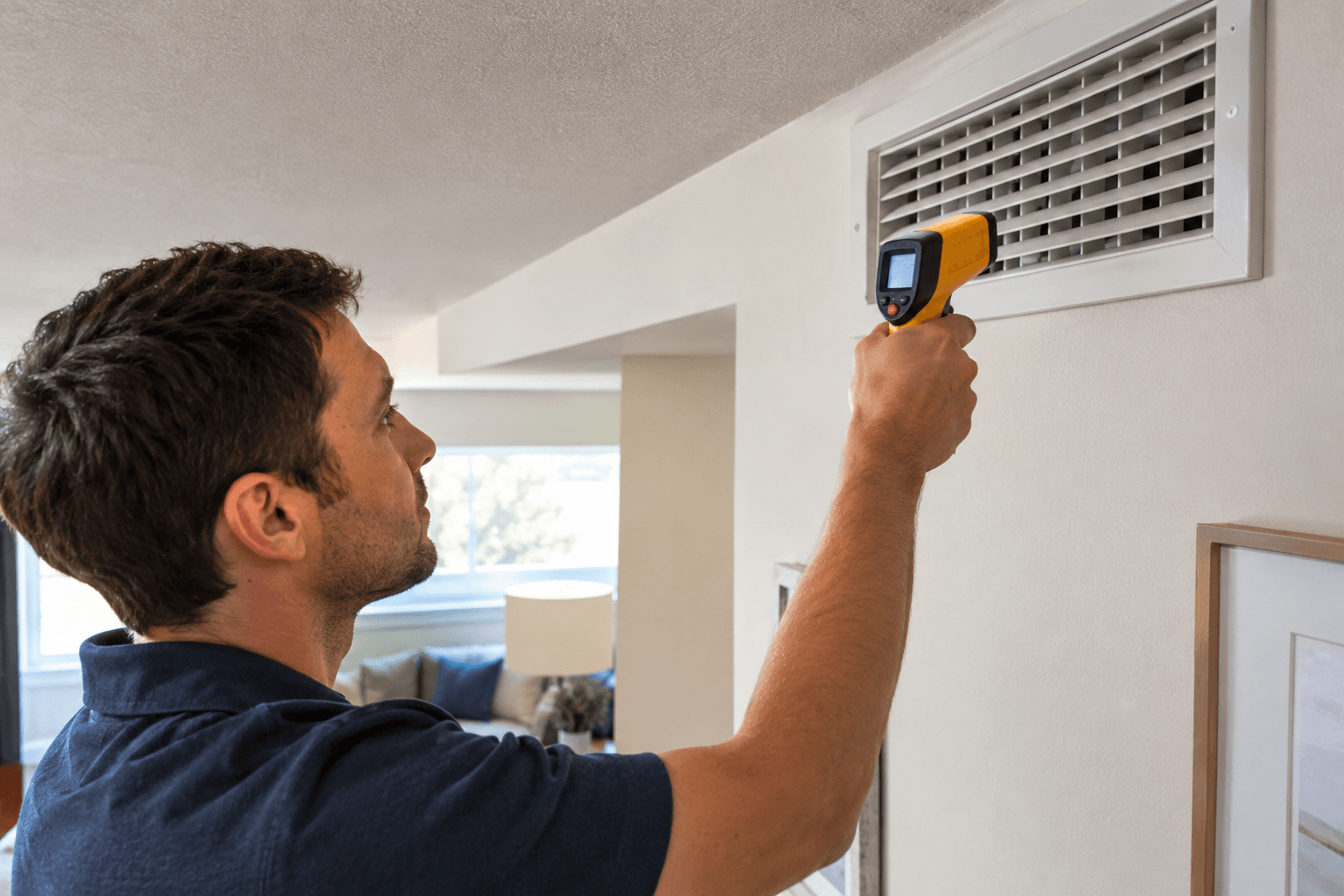
Want a measurement instead of a hunch? This quick test shows whether the system is actually cooling the air the way it should. All you need is a basic thermometer. You only need a basic thermometer.
Run the AC for 10 to 15 minutes.
Hold the thermometer in the airflow at a supply vent close to the unit and note the reading.
Take a second reading at the return grille, where air goes back into the system.
Subtract the first from the second.
A healthy system typically cools the air by roughly 15 to 20 degrees Fahrenheit. A much smaller gap points to a problem. Humidity and outdoor heat shift the number, so treat it as a strong clue, not a verdict.
Broken, or Just Struggling?
Not every weak performance is a failure.
Extreme heat: On the hottest days, even a healthy system runs for hours and may not reach your setpoint.
A dirty filter: It can choke airflow enough to make a working AC feel broken.
Thermostat placement: A thermostat in direct sun reads too warm and can mislead the system.
Closed or blocked vents: Furniture, rugs, and shut registers cut airflow to a room.
Sun-facing rooms: Some rooms simply heat faster than the system can handle.
If it keeps up in mild weather and falls behind only in a heat wave, it may be undersized or slightly low on charge. If it can't cool even on a normal day, treat it as broken.
Free Checks Before You Call Anyone
Thermostat: Set it to Cool, several degrees below room temperature, and swap the batteries if it has them.
Breaker: Check the breakers for the AC and the indoor unit. Reset a tripped one once, and don't keep resetting it.
Filter: Replace it if it's grey and clogged. Filters generally last three to 12 months, and less in busy homes with pets.
Outdoor unit: Make sure it's actually running. The indoor fan can run alone and make you think the AC is on.
Vents and drain: Open every register, and look for standing water in the drain pan or around the unit.
Ice: Switch the AC off but leave the fan on to thaw it. Light ice can clear in an hour or two, and if it returns, call a pro.
Water around the indoor unit? Drips at a vent or puddles under the indoor unit? The common causes are laid out in our AC vent leaking water piece.
What Homeowners Actually Report
Forum threads add a reality check on how to know if your AC is broken. The details differ, but the patterns repeat.
A common one is "it blows, but it isn't cold." Replies tend to start with a dirty filter, then an iced coil, then refrigerant. One new homeowner described weak upstairs airflow, and the advice pointed at partial duct or return blockages rather than refrigerant.
Another is fan-only confusion. Several replies urged checking that the outdoor unit really runs. One poster reported realizing, a year in, that the house never had an AC unit at all.
Topping off refrigerant comes up often. AC systems are sealed, so low refrigerant means a leak, and repeated top-ups without a repair only delay the bill.
Repeat failures are the costliest pattern. One homeowner went through several companies before a technician found the system had been overcharged, and another company's load calculation later showed units installed in the wrong zones. The lesson is to ask for measurements, not just a verdict.
These are anecdotes, not data, but they show where people tend to lose time and money.
Call a Pro Now, This Week or Later
Urgency | Signs | What to do |
Now | Burning smell, grinding, a breaker that keeps tripping, water leaking inside, ice that returns | Turn the system off and call |
This week | Warm air after the free checks, short cycling, weak airflow after a filter change | Book a technician |
Later | Slowly rising bills, a faint dusty smell at the start of the season | Schedule a checkup |
When you call, mention the model number, the symptoms, and what you've already tried.
What the Visit and the Bill Look Like
A technician should check the thermostat, the electrical parts, refrigerant pressures, airflow, the coils, and the drain. Ask them to explain the problem, the part, and the price before starting.
For benchmarks, Fixr puts most common AC repairs at $150 to $650, with an average near $350. A capacitor swap typically runs $100 to $400, and a refrigerant leak repair with a recharge runs $200 to $1,600. Diagnostic fees usually run $75 to $250 and are often credited to the repair. Fixr also notes that replacement deserves a look when a repair costs more than half the price of a new unit.
For anything big, get a second opinion. Our guide on what to know before you call an HVAC contractor helps you ask better questions, and the model number guide shows how to find the nameplate details a technician will ask for. If you have a ductless system, mini-split repair costs differ.
Keep It From Breaking Again
Change or check the filter monthly in summer, and replace it before the first heat wave, not during it.
Keep a couple of feet of clearance around the outdoor unit, and rinse it gently with a hose when the power is off.
Keep the thermostat out of direct sun.
Book a professional tune-up before cooling season. Our furnace tune-up test shows what a good visit should cover, and the same logic applies to AC.
FAQs
1. How to know if my AC is broken or just dirty?
Replace the filter, clear debris around the outdoor unit, and run it for an hour. If the air is still warm or weak, or you see ice, it's more than dirt.
2. Is it normal for an AC to run all day in a heat wave?
On extreme days, a healthy system can run for long stretches, but it should still cool the house noticeably. If it runs nonstop in mild weather, call a pro.
3. Why is my AC blowing warm air?
Common causes include thermostat settings, a dirty filter, an iced coil, a tripped breaker, a failed capacitor, low refrigerant or compressor trouble. Start with the free checks.
4. Can I recharge the refrigerant myself?
No. The system is sealed, so low refrigerant means a leak; buying and handling most refrigerant requires EPA Section 608 certification.
5. How much does it cost to fix a broken AC?
Most common repairs fall between $150 and $650, but refrigerant leaks and major parts can cost more.
The Takeaway
Look, listen, feel, and measure. Run the free checks first, and call a pro straight away for ice, burning smells, or grinding. That's how to know if your AC is broken before it breaks your budget. Write down the symptoms and your temperature readings before you call, so the technician starts with real clues.
About Mubashir Yaqoob
Mubashir Yaqoob researches and writes practical home repair guides for Home Repair Manual, focused on translating technical roofing, plumbing, and maintenance information into clear advice for homeowners.
View all posts by Mubashir Yaqoob