Lift the lid off a toilet tank, and most people see plumbing they don't recognize — a float, a valve, maybe a rubber flap or a strange plastic cylinder — and close it right back up without a second thought. That's usually fine, until the day it isn't: a remodel, a constant clog, a water bill that's crept up for no clear reason. At that point, knowing the actual types of toilet flush systems stops being trivia and starts being useful.
Types of Toilet Flush Systems: The Two Numbers Behind Every One
Before comparing mechanisms, two numbers explain almost everything about how a toilet performs. Every toilet sold in the US since 1994 is capped at 1.6 gallons per flush by federal law, and WaterSense-certified models go as low as 1.28 gallons; anything older can use 3.5 gallons or more per flush. Separately, independent MaP (Maximum Performance) testing scores how much waste a toilet clears in a single flush, from 250 up to 1,000 grams — WaterSense requires at least 350, and the average person's actual output per use is only around 150 grams, so a toilet scoring 500+ is genuinely strong. Every type below is really just a different toilet flush mechanism answering the same question: how do you move waste efficiently within that 1.6-gallon limit?
The Main Types, and How Each One Actually Moves Water
1. Gravity Flush
The overwhelming majority of residential toilets rely on a gravity flush toilet mechanism. Water stored in the tank simply drops when the valve opens, and its weight alone pushes waste through the trapway. No pumps, no compressed air — just physics, which is why gravity toilets are quiet, cheap to repair, and the type most plumbers reach for first. The internal valve inside a gravity system is usually one of two designs: a rubber flapper (the most common toilet flapper valve, and the most common point of failure — a warped one is the single biggest cause of a toilet that runs continuously) or a canister valve, a vertical cylinder that lifts to release water from all sides at once, generally lasting longer and flushing more forcefully than a flapper.
2. Pressure-Assisted
Instead of relying on gravity alone, a pressure-assisted toilet contains a sealed vessel that compresses air as the tank fills. When you flush, that stored pressure fires water into the bowl with real force — genuinely effective against clogs, but it needs at least 20-25 psi of household water pressure to work properly, and it's noticeably loud, closer to what you'd hear on an airplane than in a home bathroom.
3. Dual Flush
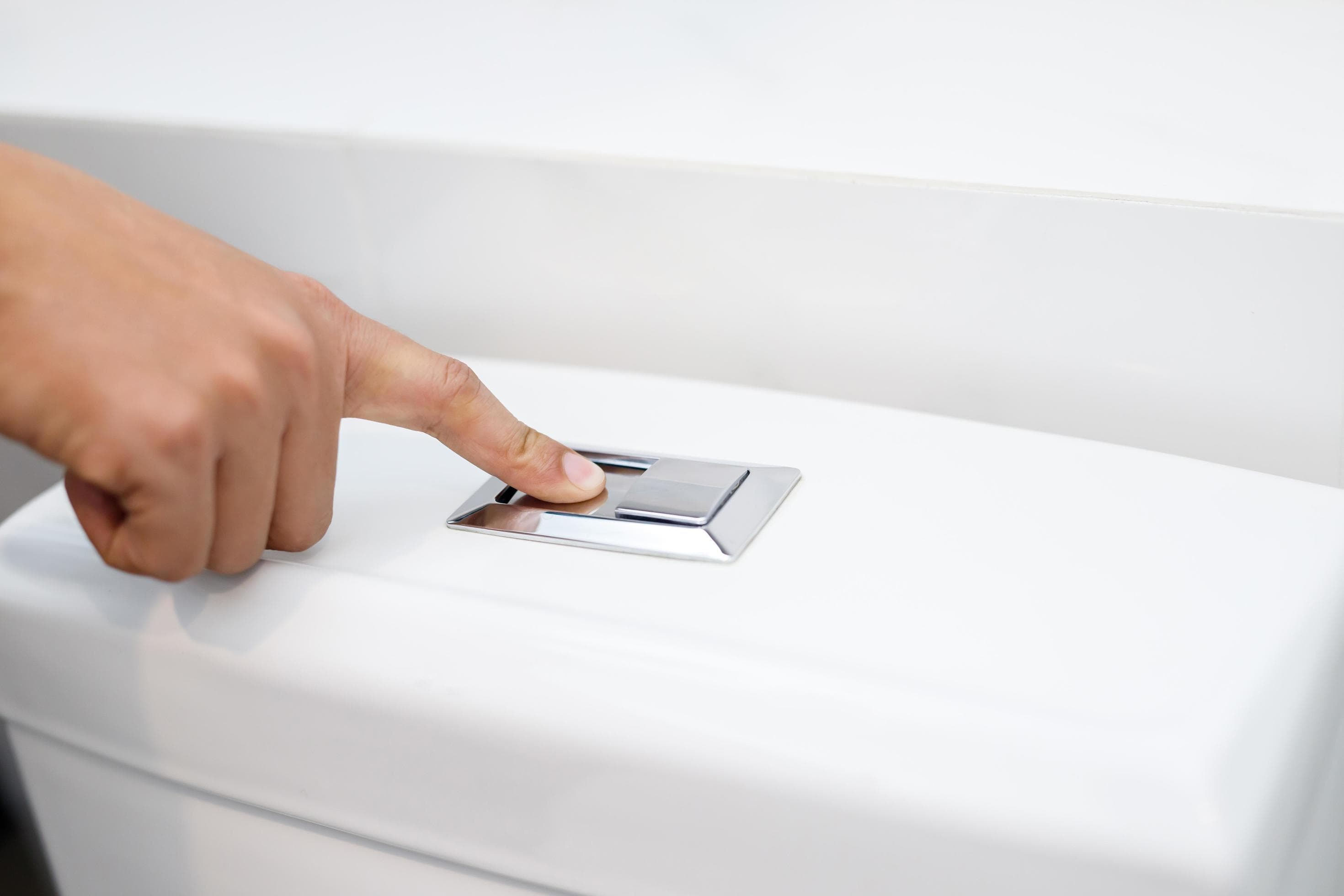
Not a different mechanism so much as a smarter control layered onto a gravity system — a dual-flush toilet uses two buttons, one for a reduced flush (roughly 0.8-1.1 gallons, meant for liquid waste) and one for a full flush. The EPA estimates dual-flush toilets save an average household more than 4,000 gallons of water a year, which is the real reason this water-efficient toilet design has become standard in new construction.
4. Siphonic vs. Washdown
Nearly every US toilet is a siphonic flush toilet: the bowl fills rapidly enough to create a vacuum that pulls waste out through a narrow, curved trapway — that's the source of the gurgling sound at the end of a flush cycle. Washdown toilets, more common in Europe, work the opposite way: a much wider, straighter trapway lets the sheer weight of the water push waste out directly. Washdowns rarely clog, but their smaller water surface means more visible residue between flushes.
5. Tankless (Flushometer)
Common in commercial restrooms, these skip the tank entirely and connect straight to a high-pressure water line through a flushometer valve, delivering an instant, powerful flush with no refill wait. They typically need a larger supply line than most homes have, which is why you rarely see a true tankless system in a residential bathroom — some "smart toilets" imitate the look with a small electric pump instead.
Decoding the Marketing Names
Toilet manufacturers love giving their engineering a brand name, which makes comparison shopping genuinely confusing. Class 5 is Kohler's name for a high-performance gravity system built around a larger canister valve — not a separate category of toilet. Tornado Flush and Double Cyclone (Toto's terms) describe angled jets that spin water around the bowl in a vortex instead of dropping straight down, scrubbing the bowl as part of the flush while still running on ordinary gravity. When you see one of these terms on a box, translate it back to the actual mechanism before comparing it against a competing brand's plain-language listing — otherwise you're comparing marketing copy, not engineering.
Matching the System to Your Actual Situation
This toilet flush comparison comes down to matching the mechanism to how you actually use the bathroom, not just picking the newest-looking option:
Older home with inconsistent water pressure — gravity or washdown, since neither depends on strong incoming line pressure the way a pressure-assisted system does; this is worth checking alongside other plumbing quirks common in older houses
Household that fights clogs constantly — pressure-assisted or a washdown-style wide trapway, both built specifically to resist blockages
Water bill or drought restrictions are the priority — dual flush, without question
Small bathroom, want a modern look — a wall-hung toilet with a concealed rear-flush tank, which frees up visible floor space
What Each Type Actually Costs to Live With
Gravity systems remain the cheapest to maintain — universal parts, no tools required for a flapper swap, and most hardware stores stock everything needed. Canister valves cost more per part since they're brand-specific, but need replacing less often. Pressure-assisted systems have the highest repair cost when something fails, since the sealed vessel isn't a simple universal part, though failures happen less frequently than a worn flapper. As a rough rule, replace the internal fill valve and flapper on any gravity toilet every 5-7 years — if you're jiggling the handle to stop a "ghost flush," that's your sign the seal has failed, closely related to what makes a toilet run or flush weakly in general.
FAQ
What's the best flush system for home use, overall?
For most households, a gravity toilet with a canister valve is the best flush system for home use — it balances quiet, reliable operation with cheap, simple repairs, without the noise trade-off of a pressure-assisted unit.
What type of toilet flush system is most common in homes?
Gravity flush, almost always using either a flapper or canister valve, accounts for the vast majority of residential toilets in the US.
Is a pressure-assisted toilet worth the noise?
If clogs are a recurring problem and your home has strong water pressure to support it, yes — the trade-off is a genuinely loud flush in exchange for real clog resistance.
Why does my toilet gurgle at the end of a flush?
That's the siphon completing its cycle in a standard siphonic system — normal on its own, though persistent or unusual gurgling can point to a separate vent issue worth ruling out.
Are dual-flush toilets actually reliable, or just a gimmick?
Genuinely reliable — it's a proven gravity mechanism with a smarter control on top, not a fundamentally different or riskier system.
How do I know which flush type is inside my current toilet?
A visible S-shaped curve on the side of the bowl means siphonic; a wide, short trapway with little visible curve suggests washdown; and lifting the tank lid shows a flapper or canister directly — if a toilet won't flush properly at all, start with the basics before assuming the mechanism itself has failed.
About Mubashir Yaqoob
Mubashir Yaqoob researches and writes practical home repair guides for Home Repair Manual, focused on translating technical roofing, plumbing, and maintenance information into clear advice for homeowners.
View all posts by Mubashir Yaqoob