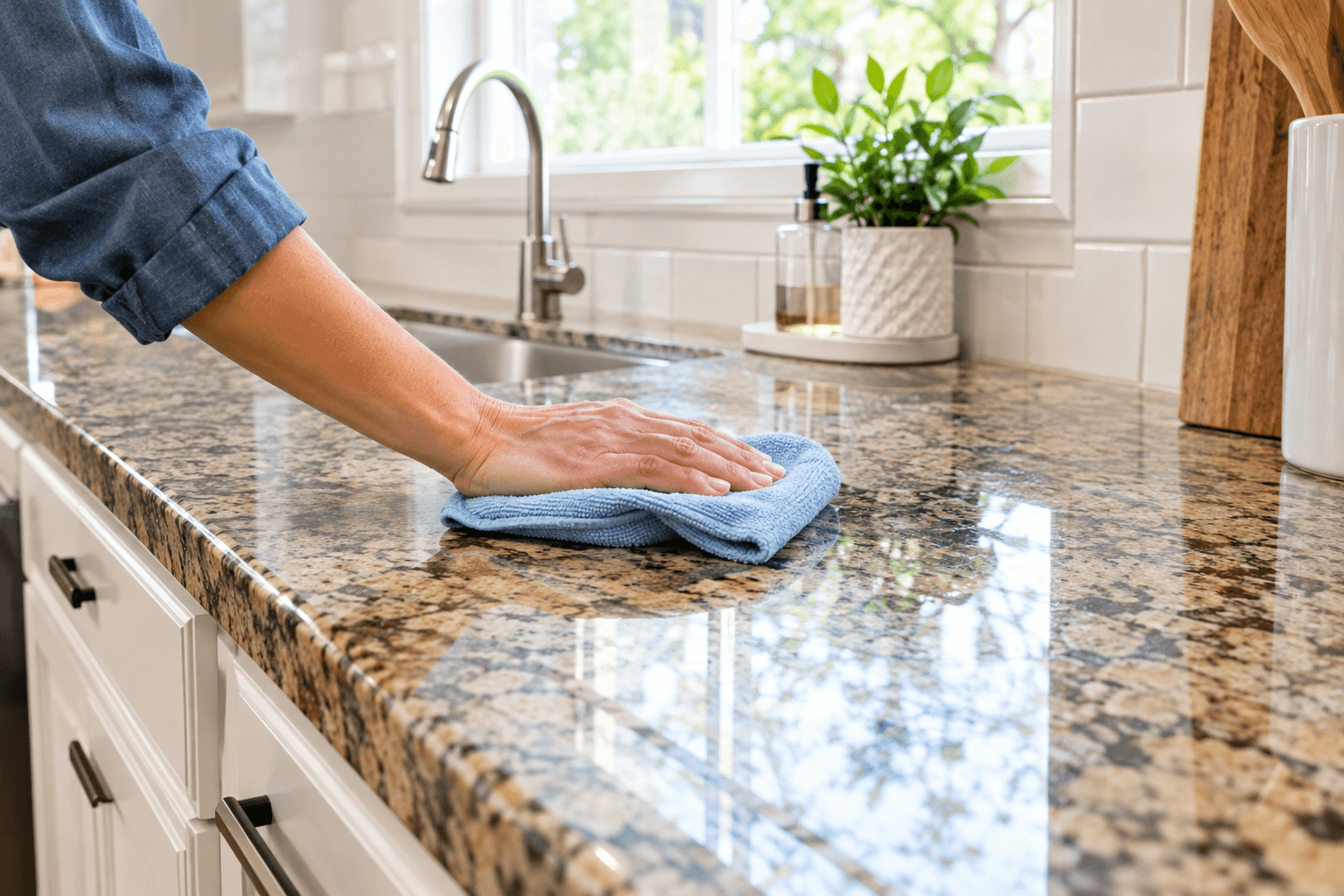
Granite has a reputation for being bulletproof. Sellers call it low-maintenance, and it mostly is. But low isn't none, and the gap between those two words is where most dull patches, dark rings and stubborn stains come from.
Here's how to maintain granite countertops without overthinking it: a simple daily routine, a two-minute test that tells you when sealing is due, and a first-aid plan for the stains that slip through.
General care guidance. Granite varies by stone, finish and sealer, so check what your fabricator or the sealer label recommends.
How to Maintain Granite Countertops: The Short Answer
Short on time? These five habits do most of the work.
Wipe daily with warm water and a mild, pH-neutral cleaner, then dry the surface
Mop up spills before they sit, especially oil, wine, coffee and citrus
Test the seal with water once or twice a year, and reseal only when the test says so
Use trivets, cutting boards and coasters, even though granite can take a lot
Leave the vinegar, lemon juice, bleach and scouring pads in the cupboard
Know Your Stone First
Granite is dense, but it isn't waterproof. Every slab has microscopic pores. Some stones and finishes have far more of them than others.
Stone | Usually | Care note |
Dark, polished granite | Less absorbent | Often holds out longer, though a quick drip check never hurts |
Light-colored granite | More absorbent and quicker to show stains | Test more often and wipe spills fast |
Honed or leathered finish | Matte surface that can show marks more easily | Use stone-safe cleaners and avoid acids |
This is also why advice online disagrees. One guide says reseal every six months, another says every three years. They aren't all wrong. They're describing different stones. Not sure what yours is? The installation paperwork or a quick call to your fabricator should tell you.
Daily and Weekly Care
Daily: Wipe with a soft cloth, warm water and a few drops of pH-neutral cleaner or a granite-safe spray, then dry to prevent water spots. Two cloths make it quicker: one damp, one dry.
After cooking: Wipe grease splashes early. Oil is the most common cause of dark patches.
Weekly: Clean around the sink, the faucet base and the edge nearest the stove, where grime hides.
Monthly: Polish with a granite-safe product if you want extra shine. It's optional.
In bathrooms: Dry splashes to avoid soap scum and hard water marks. Our step-by-step bathroom cleaning order covers the rest of the room, and any granite vanity needs stone-safe products.
Dish soap divides opinion. A few drops in a sink of warm water won't hurt most counters, but a heavy squeeze leaves a film that dulls the shine, so rinse thoroughly. A dedicated stone cleaner settles the argument.
Read the label either way. Look for "pH-neutral" and "safe for natural stone." Avoid anything with citrus, vinegar or bleach, even if it's marketed as eco-friendly or all-purpose. If a product doesn't mention granite or natural stone, skip it.
Is Your Granite Due for Sealing? Try the Water Test
Part of how to maintain granite countertops is knowing when to seal, and the water test takes the guesswork out of it.
Clean and dry the counter.
Drip a few drops of water in several spots, including near the sink and the stove.
Leave it for about five minutes.
Wipe dry and look. If the drops stay rounded on top, the seal is still doing its job. A dark patch that spreads means it's time to reseal.
To reseal, clean and dry the surface, apply a penetrating sealer made for natural stone, let it soak in as the label says, then buff off the excess. Test once or twice a year, and more often on light or honed stone and in busy kitchens. If you're unsure what was used at installation, ask the fabricator for the sealer's name and keep it handy for reordering.
Stain First Aid
Act quickly, and blot rather than wipe, since wiping spreads the mess.
Stain | Try this | Notes |
Oil or grease | Baking soda paste left overnight, then wiped off | Repeat if the mark is still there |
Coffee, wine or juice | Baking soda and hydrogen peroxide paste on light granite | Test a hidden spot first |
Hard water buildup | A granite-safe hard water remover | Skip vinegar |
Ink, rust or paint | Don't experiment | Call a stone professional |
To use a poultice:
Mix the powder with water or peroxide into a thick paste, about the texture of peanut butter.
Spread it roughly a quarter-inch thick over the stain and slightly beyond.
Cover it with plastic wrap and tape the edges.
Leave it for 24 hours, then remove it and wipe the area clean.
Repeat if needed, since stubborn stains can take a few rounds.
What Never to Put on Granite
Vinegar, lemon juice and other acids, which can etch the surface and weaken the sealer
Bleach and ammonia-based cleaners
Abrasive pads and scouring powders
All-purpose sprays that aren't labeled stone-safe
Open bottles of oil, dish soap or cleaner sitting directly on the stone
Even natural cleaners like vinegar are a problem here, because stone reacts to acid. Keep bottles on a tray instead.
Four Myths That Cause Most Granite Damage
Plenty of well-meant myths muddy how to maintain granite countertops, so let's clear four of them up.
"Granite can't stain." Resistant, yes. Immune, no: stone with a worn or missing seal soaks up spills.
"Seal it once and forget it." One application won't carry the counter through the years. Time and strong cleaners both chip away at it.
"Vinegar is a safe natural cleaner." Acid etches stone, natural or not.
"Granite is heatproof." Heat-resistant isn't the same as heatproof. Extreme or sudden heat can still mark the sealer and strain seams.
Protect the Surface, Edges and Seams
Heat: Granite handles heat well, but a trivet protects the sealer and nearby seams from sudden temperature swings.
Cutting: Use a board. Granite will usually win against a knife, but your blade loses and the sealer can wear thin.
Weight: Don't sit or stand on counters. Cracks usually start at unsupported spans near sink and cooktop cutouts.
Edges and corners: A heavy pot knocked against an edge is a classic way to cause a chip, so give corners some room.
Decor and appliances: Put felt pads under ceramic bowls and a mat under slow cookers or air fryers, since rough bases scratch and heat builds up.
Moisture: Dry around the faucet and sink rim, and fix drips. Slow leaks under the sink soak cabinets and seams, and our checklist on hidden water damage shows what to look for.
Near the hob: Grease lands here first. If you cook with gas, our guide to gas cooker maintenance helps keep that corner of the kitchen cleaner.
When Things Go Wrong
Problem | Likely cause | What to do |
Dull patches | Etching from acids or worn sealer | Clean, test the seal and ask a pro about re-polishing |
Dark spots | Absorbed oil or water | Use a poultice, then reseal |
Chips at edges | Impact | Keep the chip and ask a stone pro to fill it |
Cracks | Stress at unsupported spans or impact | Stop using that area and call a stone professional |
Gaps or lifting seams | Movement or moisture | Call the fabricator, and if the sink must be disconnected, our guide on how to hire a plumber helps |
Skip the Quick Fix
Resist hardware-store shortcuts for chips, dull spots and deep stains. Off-the-shelf fillers rarely match the color, and harsh removers can etch the surface, so you can end up with a bigger problem than the one you started with. A stone pro can blend a repair properly, and one visit is usually cheaper than fixing a DIY mess.
A Year-Round Routine at a Glance
When | Do this |
Daily | Wipe, dry and blot spills |
Weekly | Clean the edges, sink area and behind the faucet |
Monthly | Check for dull patches or new stains |
Twice a year | Run the water test |
As needed | Reseal when the test fails and call a pro for chips and cracks |
Add the water test to your seasonal checks. Our DIY home inspection checklist is a handy place to track it.
FAQs
1. How to maintain granite countertops in a busy kitchen?
Wipe up oil and acidic spills straight away, dry the surface daily, keep bottles on a tray and test the seal twice a year. Busy kitchens usually need sealing more often than lightly used ones.
2. How often should granite be sealed?
It depends on the stone. Darker, dense granite may go for years, while lighter or honed granite may need it yearly. Run the water test instead of following a fixed date.
3. Can I use vinegar or lemon on granite?
No. Acids can etch the surface and wear the sealer. Use a pH-neutral cleaner instead.
4. Is dish soap okay for granite?
For most counters, a little soap in warm water is fine as long as you rinse. If you'd rather not gamble, use a stone-safe cleaner.
5. Is it safe to set a hot pan straight on granite?
Mostly, yes. A trivet is still the easy choice, since it takes no effort and removes the risk altogether.
6. Is granite harder to maintain than quartz?
Slightly, because granite needs a periodic seal check and quartz usually doesn't. Daily care is nearly identical, and the routine above takes only a few minutes a week.
The Takeaway
Wipe it, dry it, test the seal and keep acids away. Do that, and how to maintain granite countertops stops feeling like a chore. Put a reminder in your calendar twice a year for the water test, and your counters should keep looking good for years.
About Mubashir Yaqoob
Mubashir Yaqoob researches and writes practical home repair guides for Home Repair Manual, focused on translating technical roofing, plumbing, and maintenance information into clear advice for homeowners.
View all posts by Mubashir Yaqoob